
Badges guide for trade shows, conferences and events
Quick summary: Name badge inserts are printed cards designed to slide into reusable badge holders, giving conference and trade show planners a flexible alternative to permanent or one-piece event badges. They work particularly well for multi-day events because the holder protects the printed credential while the insert can be personalized, replaced, or updated without replacing the entire badge. ConferenceBadge offers professionally printed name badge inserts in 4 × 3-inch and 6 × 4-inch formats, printed on 10pt coated stock and pre-loaded into vinyl holders, with support for attendee data, custom front-and-back designs, QR codes, and event-day printing workflows.
For a planner, that flexibility matters more than it may seem.
A badge is usually one of the last physical pieces of an event to be produced, but it depends on information that changes until almost the last minute. An exhibitor adds two booth employees. A speaker gets upgraded to VIP status. A university dean replaces a panelist. A sponsor wants its logo on the back. Someone notices that an attendee's name has been misspelled after 900 credentials have already been prepared.
A holder-and-insert system separates the durable part of the credential from the information that is most likely to change.
That is why name badge inserts have remained useful even as event technology has become more sophisticated. They can still carry variable data, qr codes, barcodes, sponsor information, attendee categories, access information, and personalized branding, but organizers retain the ability to replace the printed portion without rebuilding the entire credential.
For conferences, conventions, trade shows, university events, corporate meetings, and association gatherings, that can be a very practical middle ground between disposable DIY name tags and premium rigid credentials.
Note: Our CEO, Amanda Collett will be providing expert insights into the world of badge organization throughout this article.
Why name badge inserts still work so well for events

The easiest way to understand a badge insert is to think about what happens to an attendee credential over the course of an event.
At 8:00 a.m., it is a check-in tool.
At 10:30 a.m., it helps someone remember the name of the person standing beside them at coffee.
At lunch, the color or attendee category may help staff identify sponsors, speakers, or VIPs.
During the expo, a QR code may support lead retrieval for events.
At an evening reception, the same badge continues helping strangers make introductions.
Then the next morning, it has to do all of those things again.
This is one reason reusable badge holders are particularly useful for multi-day events. Avery similarly distinguishes insertable badge holders as an option suited to multi-day events, while adhesive formats make more sense for shorter uses. Its common insert products include both compact 2.25 × 3.5-inch and larger 3 × 4-inch formats.
ConferenceBadge takes that familiar model and turns it into a managed event product. Its inserts are printed on 10pt coated paper, cut to size, loaded into vinyl holders, and shipped ready for registration teams to distribute. Current formats include 4 × 3 and 6 × 4 inches, with front-and-back customization and support for QR codes.
That removes an often underestimated amount of manual labor.
Ordering 800 paper inserts is one task. Printing, trimming, matching them to holders, checking orientation, loading 800 holders, adding lanyards, sorting them, and fixing mistakes is another.
“What I’ve noticed at conferences is badge assembly becomes a production line. 1-person organizing, 1-person creating the badges, 1-person printing. While this works at a small conference of 200 - 300 people, if you have 1000+ attendees this can be a full day’s work for multiple people. An example I experienced this in is InnovateWest 2024 in Vancouver. Between matching inserts, checking names, attaching lanyards and sliding inserts, organizing speakers and VIPs AND the million last minute changes, having badges arrive that are ready can literally save you thousands of dollars of time and effort. ”
Professional trade show badges for every event role
A trade show is one of the clearest examples of why event credentials need to do more than display a name.
The exhibition floor may contain attendees, exhibitors, sponsors, media, vendors, speakers, staff, buyers, contractors, VIPs, and other visitors at the same time. Each group may have different access, responsibilities, and reasons for being there.
Strong Trade Show Badges help communicate those differences without making staff repeatedly open an attendee record.
Imagine an industry expo with 2,500 participants.
An attendee badge might show a large first name, company, and job title. An exhibitor badge could add the company name and booth number. Sponsor representatives might have a distinct designation. Staff credentials may need to be recognizable from considerably farther away. A VIP credential may use a separate visual treatment altogether.
The important part is consistency.
If "EXHIBITOR" appears at the top on one credential, in tiny text at the bottom on another, and is communicated only through a slightly different shade on a third, the visual system breaks down.
ConferenceBadge supports multiple badge types and customizable front-and-back designs, which allows the same underlying event identity to be adapted for different attendee roles.
This is where custom event badges become operational rather than decorative.
A badge is helping answer:
Who is this person?
Why are they here?
Where might they be allowed to go?
How can I connect with them?
Conference badges that answer those questions quickly reduce friction throughout the event.
What should a name badge insert actually contain?

It is tempting to treat the unused space on a badge as an opportunity:
The events team wants the logo.
Sales wants the QR code.
Sponsorship wants sponsor logos.
Operations want an access zone.
Programming wants a schedule.
Networking wants a company name and title.
Someone else asks whether the attendee's city, chapter, dietary status, pronouns, membership type, table assignment, and registration number can fit too.
Technically, they may.
That does not mean they should.
Good badge design creates hierarchy. The information people need most frequently should be the easiest to find.
For many professional events, that means:
First and last name
Company or organization
job titles, where useful
Event or attendee category
Event branding
Exhibitor or sponsor status when relevant
Booth number where useful
A QR code or barcode when it supports a real workflow
Access information only when attendees or staff actually need it
Cvent likewise recommends using role segmentation and key attendee information when designing conference credentials and notes that well-designed badges can support both networking and event logistics.
The test is simple: put the finished insert inside its actual holder, attach the lanyard, put it on someone, and look at it from a conversational distance.
If you need to lean in to read the attendee's name, the layout has failed regardless of how attractive it looked in the design file.
That is also why a strange keyword such as font event name tag ultimately points toward a legitimate planning question: what font should an event name tag use? The answer is usually one that prioritizes legibility over personality. Event branding still matters, but names should not compete with decorative typography.
The same logic changes depending on the physical environment. A tightly arranged conference room layout puts attendees close together. A convention hall places people farther apart and in motion. The latter usually rewards larger names and larger credentials.
Choosing the right badge size for an insert-and-holder system
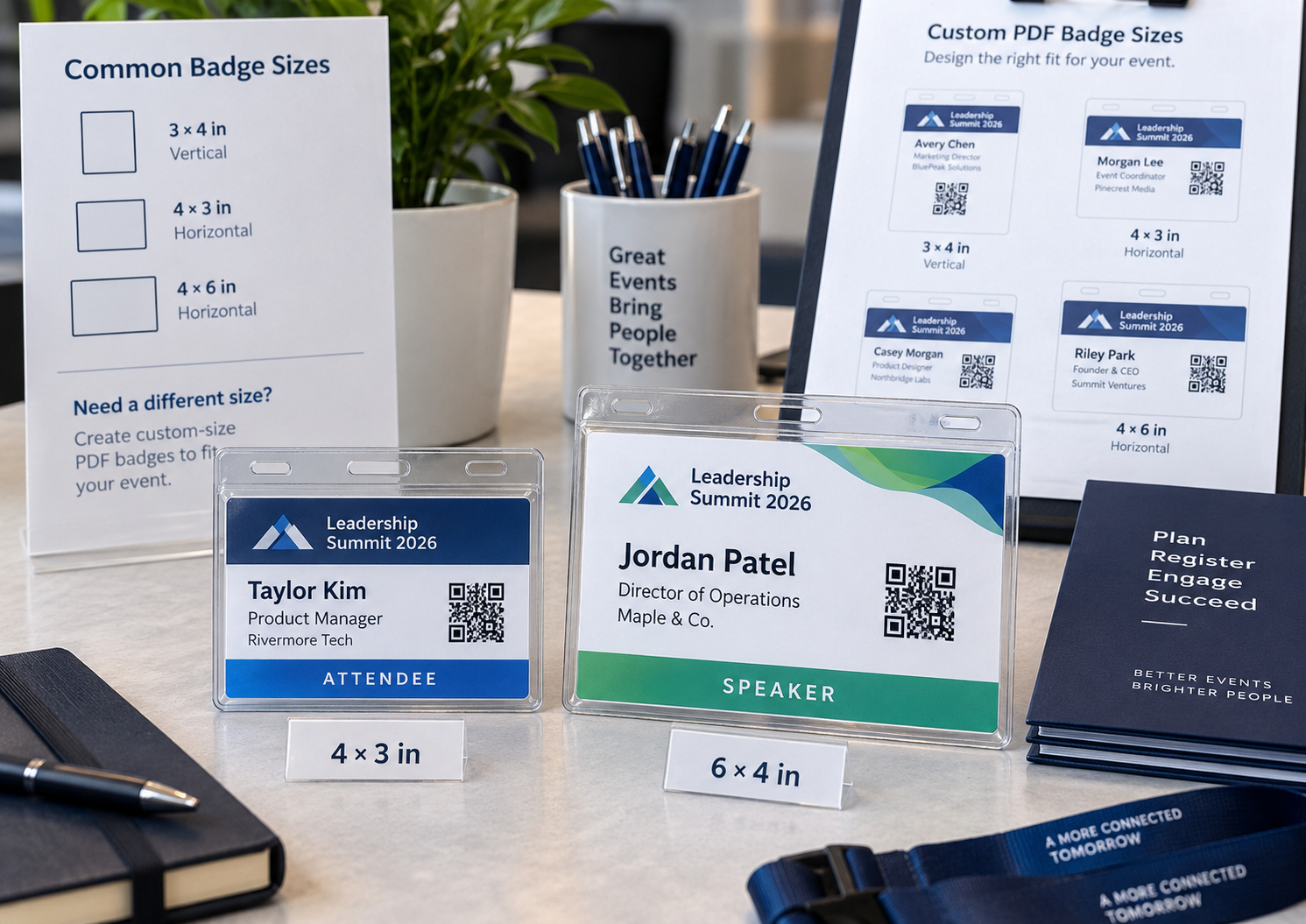
The right badge size is not simply the smallest size that can contain the data.
It should reflect how the credential is going to be used.
ConferenceBadge currently offers its printed insert-and-holder badges in 4 × 3-inch and 6 × 4-inch formats. Across its broader product line, it also supports custom-size PDF badges, while its event badge guidance identifies 3 × 4 and 4 × 6 as common professional-event formats.
A smaller insert works well when the badge primarily needs to support introductions. A larger format gives the organizer more breathing room for exhibitor designations, QR codes, schedules, access information, or larger names.
That becomes especially relevant for networking.
At a 70-person seminar, someone can easily ask the person beside them for their name.
At a 5,000-person trade show, attendees are constantly moving. A larger credential can help people recognize one another before starting the conversation.
For this reason, event badge sizes should be chosen after the use case has been defined, not before.
Avery's standard insert ecosystem demonstrates the same range. It sells 2.25 × 3.5-inch and 3 × 4-inch inserts for traditional holder-based name badges.
For a large conference or expo, ConferenceBadge's 6 × 4 option provides considerably more visual space when names need to be seen farther away.
Name badge inserts, cardboard badges, or plastic event badges?
No event credential format is universally superior.
The useful question is what the badge needs to survive and what flexibility the planning team needs after printing begins.
ConferenceBadge currently offers several different production paths, including downloadable PDFs, Cardboard Badges, inserts and holders, laminated PVC badges, and On site printing.
| Badge option | Best suited to | Main advantage | Tradeoff |
|---|---|---|---|
| Name badge inserts + holders | Conferences and multi-day events | Insert can be swapped while the holder is reused | Requires a holder |
| Cardboard badges | One-day conferences and events | No plastic holder required | Less protected than a holder-based badge |
| PDF badges | DIY or decentralized printing | Flexible size and local printing | Organizer controls printing and assembly |
| Laminated PVC plastic badges | Premium or durable events | Waterproof and rigid | More permanent than an insert |
| Blank inserts | Walk-ins and corrections | Easy event-day replacement | Requires an onsite printing process |
ConferenceBadge describes its inserts-and-holders product as particularly suitable for multi-day events and currently prints the inserts on coated stock before pre-loading them into vinyl holders. Its laminated PVC option is a separate 6 × 4-inch rigid credential.
That distinction matters.
A plastic event badges strategy may make sense for a premium summit, outdoor activation, or credential expected to encounter substantial wear. Inserts may be more useful when information has a greater chance of changing.
Consider a three-day association convention.
On day one, a delegate is simply an attendee. On day two, she moderates a panel. The organization may want to replace or update part of her credential without discarding an entire rigid badge.
An insert-and-holder system makes that relatively easy.
A one-day customer event with a very stable guest list may get less value from the same flexibility.
Why badge holders matter more at multi-day events

The holder does not get much attention during event planning because it does not contain the interesting information.
Yet it is the part of the credential taking most of the physical abuse.
It gets handled during registration, pulled against a lanyard, dropped into bags, placed on lunch tables, rubbed against clothing, and sometimes exposed to coffee or rain.
For one-hour networking events, this barely matters.
For three-day conventions, it does.
ConferenceBadge uses vinyl holders with its insert products and specifically positions the format for multi-day conferences, association meetings, and academic events.
A holder also gives planners options.
The printed insert does not need its own punched attachment point. It can be replaced while the wearable hardware remains intact. The holder can accommodate a pin or clip-style attachment depending on the product, although lanyards are typically the more practical solution for larger conferences where badges need to remain visible.
Avery similarly sells hanging, clip-on, and pin-back badge options, reflecting the fact that attachment choice depends on the environment and intended wear time.
There is one critical operational detail: order the holder and insert as a system.
A 4 × 3 insert does not help if the event team accidentally buys holders intended for another dimension or orientation.
It sounds obvious until 1,000 incompatible pieces arrive at a venue.
Lanyards complete the wearable experience

A badge does not function well if attendees constantly turn it over, hide it in a pocket, or remove it because the attachment is uncomfortable.
For large events, lanyards remain popular because they keep credentials visible without attaching anything directly to clothing.
ConferenceBadge currently offers standard black polyester lanyards with single clips and also lists custom lanyards through a custom-quote workflow with logo, color, and single- or double-clip options.
The orientation has to match the badge.
A single clip can allow a large badge to rotate. Two attachment points can help stabilize some larger credentials. A horizontal insert may require a different setup from a vertical credential.
Branding creates another decision.
A sponsor-branded lanyard can provide significant visibility because it is worn by attendees throughout the event. But excessive visual competition between the lanyard, credential, multiple sponsor logos, and category colors can make the badge look less organized.
The badge and lanyard should be designed as one visual system.
Using QR codes on name badge inserts
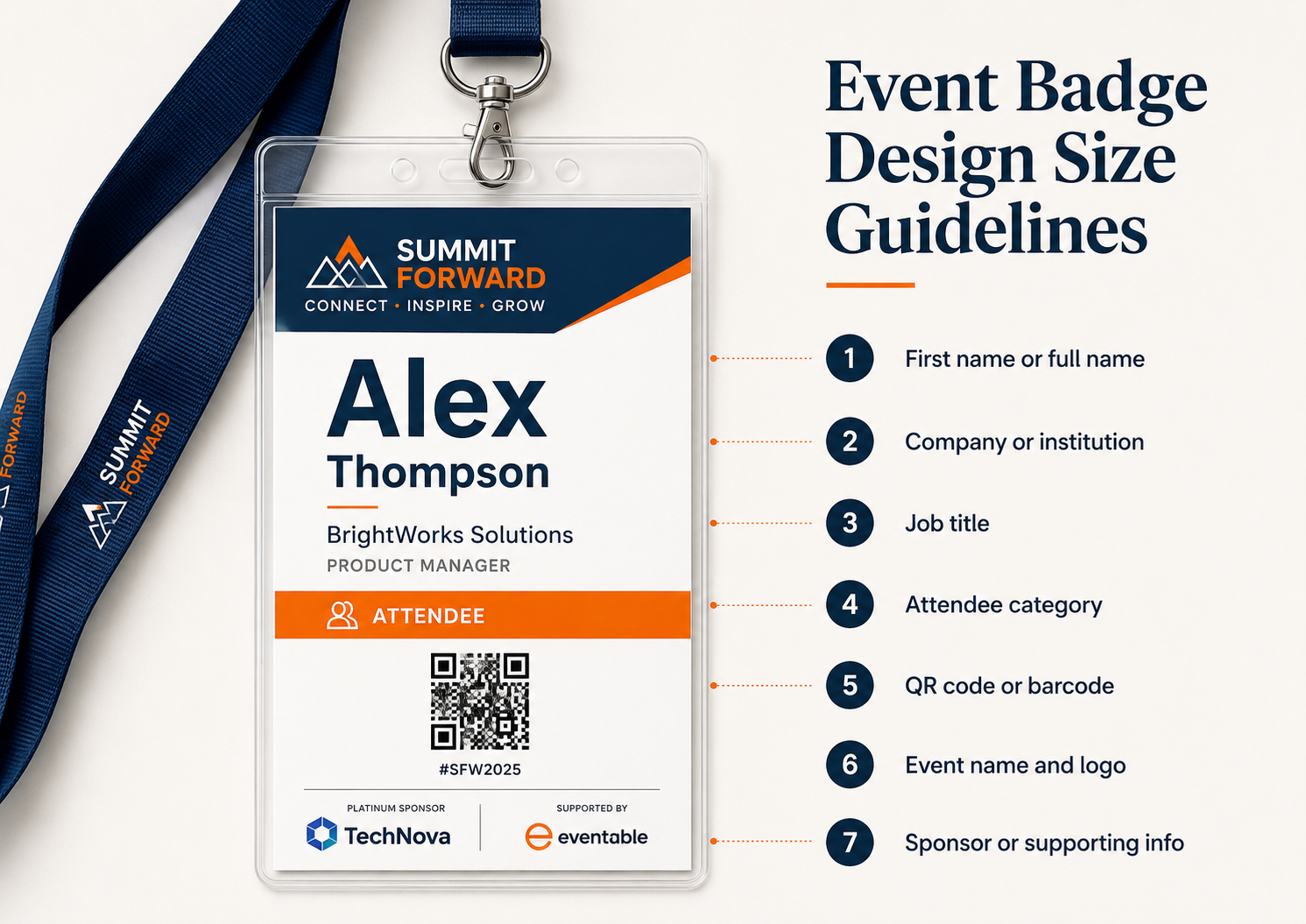
Putting a QR code on a badge is easy.
Making it useful is harder.
QR codes for events can support check-in, contact exchange, networking, access control, session tracking, or lead retrieval. But each use case depends on what sits behind the code.
EventMobi's current badge guidance makes an important distinction: an operational event QR code can act as an identity key connected to an attendee record rather than simply behaving like a marketing QR code that points everyone to the same webpage.
Imagine two versions of a trade show badge.
First, every QR code opens the conference homepage.
On the second, each code carries or resolves to a unique attendee identity that an authorized lead retrieval workflow can recognize.
Both badges contain QR codes.
Only one meaningfully improves the exhibitor interaction.
ConferenceBadge supports QR codes and barcodes in its designs, and its lead retrieval product allows exhibitors to scan attendee badge QR codes using a browser, capture notes and qualification information, and export leads for follow-up.
That turns the badge into an active part of the customer journey.
How trade show badges can make networking easier
People often describe networking as something attendees either do or do not do.
Event design can make it considerably easier.
A badge helps by reducing the first few seconds of friction.
Instead of:
"Sorry, what was your name again?"
an attendee can move directly to:
"I saw you're with Acme. What are you working on there?"
The difference is small, but repeated hundreds of times it changes the texture of an event.
Strong conference badges make names highly readable, give enough company or role context to create a conversation starter, and avoid burying that information under event graphics.
Trade Show Badges can go further by identifying buyers, exhibitors, sponsors, or areas of professional interest.
Cvent notes that personalized conference badges can support networking as well as event logistics.
Technology can then extend the interaction.
A QR-based networking or lead capture system can allow two people to preserve the connection after the physical conversation ends. ConferenceBadge's Lead Retrieval for events product is designed around that transition from badge scan to captured exhibitor lead.
The badge does not create a good conversation.
It removes obstacles around one.
“Badges are meant to be a conversation starter. When organizers include company names, roles, type of attendee and even an area of interest; people can make an instant connection. At one conference at Web Summit 2022 in Lisbon, Portugal , I once saw two competitors pick each other out of a crowd and for the rest of the night they were engaging with each other at every breakout session at dinner and even the after event. ”
Using badges to understand attendee engagement
Scanning introduces another dimension to the credential: measurement.
A QR code or barcode can associate an interaction with an attendee record, depending on the event's underlying system and privacy approach.
That can support event use cases such as:
Entrance check-in
Workshop attendance
Seminar attendance
Session access
Exhibitor lead capture
VIP-area entry
Networking
Credential verification
This is particularly relevant for workshops and seminars where organizers need to understand participation at a more granular level than overall event attendance.
But tracking should have a defined purpose.
Scanning every attendee at every doorway generates data. It does not automatically generate useful information.
An organizer should begin with the decision the data will support.
If session attendance helps determine which programming should return next year, the scan has a purpose. If booth scans feed exhibitor follow-up, the scan has a purpose. If access scans enforce room capacity or permissions, the scan has a purpose.
Then the organizer can supplement behavioral data with post event survey questions asking what attendees found valuable, whether networking was easy, and which sessions were most useful.
The combination tells a better story than either source alone.
Inserts for attendees, exhibitors, sponsors, speakers, and VIPs

One advantage of a custom design system built around variable data is that different participant types do not require completely separate production workflows.
The underlying credential can remain consistent while specific fields, labels, or visual treatments change.
Attendee inserts
General attendees usually need the cleanest design. Name, company, title, and an attendee category are often enough.
The mistake is treating general admission as permission to fill every unused space.
These are the people doing most of the networking. Readability matters.
Exhibitor inserts
Exhibitors often benefit from a prominent "EXHIBITOR" designation, company name, and booth number.
At a busy expo, that saves attendees from wondering whether the person they have approached works for the exhibiting company.
A separate exhibitor category can also help operations control early floor access where appropriate.
Sponsor inserts
Sponsors may deserve stronger visual recognition than standard attendees.
That does not mean the entire credential has to become an advertisement.
A sponsor designation or logo can provide recognition while preserving the attendee's identity as the primary information.
Speaker inserts
Speakers frequently need to be recognizable to both attendees and event staff.
A visible speaker designation can help with session coordination, green room access, introductions, and networking.
VIP inserts
vip badges or vip passes are particularly useful when the designation corresponds to a real operational difference: premium seating, private receptions, backstage access, hosted-buyer programs, executive sessions, or hospitality areas.
If VIP is only decorative, the distinction has limited practical value.
Staff and security inserts
Staff credentials should be recognizable from farther away than attendee badges.
When someone needs help, they should not need to inspect five badges before identifying the right person.
This is one place where strong category colors can be particularly effective.
Media and guest inserts
Press, photographers, special guests, and other visitors may need their own identifiers when their access differs from normal registration.
The lesson across every category is the same: create a new badge type because it solves an event problem, not simply because the software allows one.
When inserts are better than permanent credentials
Some events need a badge that lasts three hours.
Some need one that lasts three days.
Others need credentials durable enough for repeated outdoor use, controlled zones, or staff operations.
A conference insert and vinyl holder makes sense when flexibility and multi-day wear matter.
A rigid id badge or PVC format may make more sense when durability is the priority.
A concert or festival, for example, may rely more heavily on weather resistance, backstage passes, crew identifiers, vendor access, and visual vip passes. Certain applications may therefore favor laminated or pvc plastic credentials instead of paper inserts.
Similarly, premium full color printing, special finishes such as soft touch, unconventional shapes created through die cutting, or unusual attachments may call for a specialized custom print vendor.
ConferenceBadge's present product line focuses on standardized event-ready formats rather than pretending every possible credential production method belongs in one system. Its current products include PDF badges, cardstock badges, inserts and holders, laminated PVC badges, onsite options, and lanyards.
For planners comparing Conference badge alternatives, this is the more useful way to evaluate products.
Start with the operating environment.
Then choose the material.
From attendee data to finished name badge inserts
The finished insert is only as good as the information that creates it.
Most event teams already have attendee data somewhere.
The challenge is getting it into the badge without repeatedly retyping information.
Start with attendee and exhibitor data
ConferenceBadge supports attendee importing and variable information in badge designs.
For many planners, the source begins as name badges from Excel, CSV information, or an export used for name badges from Google sheets.
This is where badge printing software changes the workflow.
Rather than creating 700 independent design files, the planner creates a template and allows the attendee data to populate it.
That is also where badge integrations and broader conference software or conference planning tools can become relevant. If the registration source can provide clean attendee fields, badge creation is easier. If the source data is inconsistent, every downstream step inherits the inconsistency.
A registration record with:
First name: Christina
Last name: Rodriguez
Company: Atlantic Bio
Role: Exhibitor
Booth: 317
is easy to map.
A single cell containing:
"Christina Rodriguez / Atlantic Bio / Exhibitor booth 317"
is much harder.
The badge project exposes data problems that often existed long before printing began.
Why proofing matters before full event badge printing
A proof should try to break the design.
Do not only review the shortest name in the attendee list.
Find the longest.
Do not test the QR code on your monitor.
Print it.
Do not assume the sponsor logo looks fine.
Look at it inside the holder.
Do not proof only the attendee badge.
Generate an exhibitor, speaker, VIP, sponsor, and staff credential.
A professional event badge printing workflow needs to account for what happens when real variable data enters a design.
One attendee has a six-letter company name.
Another has 36 characters.
One person's job title is "CEO."
Another takes two lines.
The template needs to accommodate both without turning the second badge into an unreadable exception.
ConferenceBadge's editor supports attendee importing, multiple badge types, double-sided designs, QR codes, and barcodes, giving organizers the building blocks to test those variations before production.
“I once supported a conference where they did get their badges mailed, organized and created using another software. However, this software had a severe limitation when it came to longer names (especially people). While the badges looked good for characters under 50, names over 50+ ended up spilling outside the designated area making some attendees’ badges look ridiculous. Always know what upper and lower limits are of the badges you’re creating, and ensure that those limits are double checked before printing. ”
Handling last-minute registrations and onsite changes
No matter when the print deadline is set, someone will register afterward.
That is not a failure of planning.
It is part of event planning.
The real question is whether the team has designed a workflow for it.
ConferenceBadge's current On site printing workflow is intended for last-minute attendees, typo corrections, and similar changes. Its Print Center works through a browser and can generate badges through consumer-grade printers without requiring proprietary printer hardware.
For insert-and-holder events, this is particularly useful.
The organizer can have the majority of credentials professionally printed and pre-loaded while keeping extra blank insert media and holders available for exceptions.
Imagine a 900-person university conference.
Eight hundred seventy attendees are printed in advance. On event morning, 12 people register late, five require title corrections, and three badges are missing.
Without a reprint process, registration staff start reaching for markers.
With one, those 20 exceptions are simply another queue.
This hybrid approach avoids making the entire event dependent on onsite printing while preserving flexibility for the small percentage of attendees most likely to change.
How long should planners allow for production?
Badge ordering has two timelines.
The first is physical production time.
The second is decision time.
ConferenceBadge currently advertises a fast two-business-day turnaround option for its inserts and holders, with delivery in the USA and Canada. Its shipping guidance also lists three-business-day and faster options, while larger orders may require different planning.
That does not mean planners should begin two days before the event.
The design still needs to be approved. Attendee fields need to be decided. Data should be cleaned. QR codes need to be tested. Shipping needs to reach the correct person at the correct venue or office.
More importantly, the event team needs enough time to react if something is wrong.
The safest planning principle is therefore to start the badge structure once the event branding, attendee fields, categories, and approximate count are known.
The final attendee names can come later.
Name badge inserts versus DIY name tags

There is a scale at which DIY makes perfect sense.
A 15-person board meeting does not necessarily need professional badge production.
A small HR workshop may be perfectly served by an office printer and blank insert stock.
Avery provides standard printable insert templates for exactly these kinds of workflows, including common 3 × 4-inch name badge inserts.
https://www.avery.com/templates/category/name-tags-badges
Problems arise when DIY production is scaled without reconsidering the labor behind it.
Printing 500 inserts from Word is not only a printing task.
Someone needs to:
Clean the list
Create the merge
Fix overflow
Add role logic
Generate codes
Match stock to the printer
Print test sheets
Correct alignment
Separate the inserts
Load the holders
Organize credentials
Deal with reprints
This is why searches for custom name tags, name badges from Excel, or name badges from Google sheets often eventually lead planners toward a managed badge workflow.
Nothing is inherently wrong with the DIY method.
The event has simply reached the point where staff time becomes part of the cost calculation.
ConferenceBadge's insert-and-holder workflow
ConferenceBadge's current inserts-and-holders product is designed to remove several manual steps from that process.
Planners design the badge, import attendee information, and choose the appropriate credential setup. ConferenceBadge prints the inserts, cuts them, places them into vinyl holders, and ships the assembled credentials. Current listed options include 4 × 3 and 6 × 4 inserts printed on 10pt coated paper stock, with front-and-back customization.
That matters because a product advertised at "$X per badge" is not always comparable to another product advertised at "$X per insert."
One price may represent blank stock.
Another may represent printing.
Another may include the holder.
Another may include assembly.
ConferenceBadge currently lists inserts and holders starting from $2.19 per badge, including printing, cutting, holder loading, and shipping to one address in Canada or the United States on the product page.
The more useful comparison is therefore the finished credential arriving at registration.
A practical trade show badge product mix
Large exhibitions often need more than one credential product.
An attendee may need a normal insert.
A VIP may need a more visually prominent credential.
Some staff may need rigid credentials.
Late registrants need onsite-printable stock.
Sponsors may want branded lanyards.
The badge strategy can therefore be built as a small system rather than forcing everyone onto the same output.
Trade show badge design that works in the real world

An effective badge should survive three tests:
Can I read it?
Can I understand it?
Can I use it?
The first is about typography.
Make the person's name large enough to read. Do not allow an oversized event logo to force names into small type.
The second is about hierarchy.
If exhibitors, attendees, speakers, and staff need to be distinguished, make those labels obvious and consistent.
The third is about function.
If the badge contains a code, scan it. If the badge controls access, verify that staff understand the visual or digital identifier. If it is intended to support networking, make sure company and role information are actually visible.
For custom badges, restraint is usually more valuable than another visual effect.
full color printing, unusual die cutting, soft touch finishes, a striking custom design, and elaborate graphics can all make a credential feel premium. They cannot rescue poor information hierarchy.
The same applies to unusual shapes.
A circle or custom-cut credential may look impressive on a table but rotate badly on a lanyard, leave limited horizontal room for long names, or fail to fit standard badge holders.
Function should lead the form.
Why event teams choose ConferenceBadge for name badge inserts
ConferenceBadge is specifically focused on event credentials rather than general commercial printing.
That distinction shows up in the surrounding workflow.
The current platform supports attendee importing, multiple badge types, custom front-and-back design, QR codes and barcodes, PDF generation, printed products, holders, lanyards, and onsite printing options.
Its insert product also addresses a mundane but valuable part of event preparation: ConferenceBadge prints, cuts, and pre-loads the insert into the holder before the order arrives.
For an event planner, that means the buying decision is not simply "Where can I purchase plastic holders?"
It is:
How do we get accurate, branded credentials into attendees' hands without turning the week before the event into an assembly line?
For many events, that is the more important question.
Start your badge project by signing up with us now.
Name badge insert and trade show badge checklist
Before final production, review the complete badge experience rather than only the artwork.
Confirm attendee, exhibitor, sponsor, speaker, VIP, vendor, and staff counts
Confirm each badge category
Choose the final badge size
Match inserts to compatible badge holders
Confirm lanyard attachment
Clean attendee data
Check long names and job titles
Add booth numbers where appropriate
Confirm sponsor recognition
Decide whether QR codes or barcodes are needed
Test every code at the final printed dimensions
Review all badge categories
Test the longest attendee name
Review front and back
Plan late-registration printing
Keep spare inserts and holders
Sort credentials before registration
Confirm shipping destination and production schedule
Test lead retrieval where used
Test access workflows where used
Have staff wear a completed badge before approving production
The final step is surprisingly valuable.
A credential sitting flat on a monitor is not an event badge.
Put it in the holder. Attach the lanyard. Wear it around the venue. Try to read it while walking toward someone.
That is the environment it has to succeed in.
Frequently asked questions about name badge inserts and trade show badges
What are standard event badges?
Standard event badges are credentials used to identify attendees, exhibitors, sponsors, speakers, staff, VIPs, media, vendors, and other participants at conferences, expos, meetings, and trade shows.
They may take the form of printed paper inserts inside holders, cardboard credentials, adhesive name tags, PDF-printed credentials, or rigid plastic badges. Common event sizes include approximately 3 × 4 inches and 4 × 6 inches, although the appropriate size depends on readability, information density, and event use. ConferenceBadge currently offers 4 × 3 and 6 × 4 inserts and holders.
What shapes are available for name tags and badges?
Rectangular badges remain the standard because they accommodate names, logos, titles, QR codes, and standard holders efficiently.
Custom printers can create circles, squares, custom-cut shapes, or credentials using die cutting, but non-standard shapes introduce trade offs around holders, lanyard attachment, printing, and usable text space. ConferenceBadge's current insert-and-holder products use rectangular 4 × 3 and 6 × 4 formats.
What attachment works best for convention badges?
For most large conferences, lanyards work well because they keep credentials visible and avoid attaching pins or adhesives to attendee clothing.
Clip or pin attachments may suit smaller or shorter meetings. Avery offers hanging, clip-on, and pin-back badge approaches, illustrating that the best choice depends on wear time and event format.
For large convention badges, make sure the attachment is compatible with the holder orientation and keeps the credential facing outward as consistently as possible.
Can convention name badges have QR codes?
Yes. ConferenceBadge supports QR codes and barcodes in its conference badge designs, including inserts-and-holders credentials.
QR codes can support check-in, networking, lead retrieval, attendee verification, or other event workflows. The code should always be tested at its final printed size and with the actual scanning method intended for the event.
How long does it take to produce custom event badges?
ConferenceBadge currently advertises a fast two-business-day turnaround option on inserts and holders as well as certain other printed products. Shipping and production requirements can vary with order size and selected delivery method, particularly for larger orders.
Planners should still begin earlier so there is time for data preparation, design, proofing, scan testing, production, shipping, and corrections.
Can I order vendor or exhibitor badges separately from attendee badges?
Yes, event badge designs can use different badge types for exhibitors, vendors, sponsors, staff, speakers, VIPs, and attendees. ConferenceBadge supports multiple badge types within its workflow.
Separating exhibitor credentials is often useful when booth personnel have different access periods, floor privileges, company information, or identification requirements from general attendees.
How can trade show badges be used to improve networking opportunities?
Trade show badges improve networking when the information needed to start a conversation is immediately visible.
Large names, company information, useful job titles, attendee categories, and clearly identified exhibitors reduce the work required to approach someone. QR-enabled credentials can extend the interaction by supporting digital contact exchange or lead retrieval after the conversation.
Cvent similarly notes that thoughtful badge personalization and segmentation can improve event networking.
How can trade show badges be used to track attendee engagement?
A unique QR code or barcode can connect badge scans to specific event workflows such as check-in, workshops, sessions, expo interactions, or lead retrieval when the underlying event technology supports those functions.
EventMobi describes QR-enabled badges as being usable with registration and check-in data for functions including session tracking and lead retrieval.
Tracking should be designed around a clear operational or analytical purpose and appropriate attendee-data practices rather than scanning simply because the technology is available.
What information should be included on a trade show badge?
Most trade show credentials should prioritize the attendee's name, company, useful role information, and attendee category.
Depending on the event, it may also make sense to include the booth number, sponsor status, access level, event logo, QR code, barcode, or regional information.
Do not include every available field merely because there is room. The badge should remain readable from conversational distance.
How can I design an effective trade show badge?
Start with function rather than decoration.
Make names large. Create a consistent hierarchy. Distinguish exhibitors, speakers, sponsors, staff, and VIPs when those distinctions matter. Avoid overcrowding. Leave adequate clear space around QR codes. Match the design to the actual holder and attachment. Then print a physical proof before production.
The most important test is whether another attendee can quickly identify the person while both are standing or moving through the event.
What types of trade show badges does ConferenceBadge offer?
ConferenceBadge currently offers downloadable PDF badges, printed Cardboard Badges, inserts and holders, laminated PVC badges, onsite printing options, and lanyards. Its platform also supports attendee imports, custom designs, multiple badge types, QR codes, and barcodes.
Do exhibitors need different badges than attendees?
Often, yes.
Exhibitors may need a visible exhibitor label, company, booth number, sponsor designation, or access privileges that do not apply to normal attendees.
Freeman's trade show research also identifies booth-staff badges as a basic exhibitor need, reinforcing that exhibitor credentials are an operational part of expo planning rather than merely a design variation.
Can I order badge inserts, holders, and lanyards together?
ConferenceBadge's printed insert product includes the insert and vinyl holder, with inserts printed, cut, and loaded before shipping. Standard black lanyards can also be added to an order, while custom lanyard options are available through a quote workflow.
What size should trade show badges be?
The correct size depends on viewing distance, badge-holder compatibility, orientation, data requirements, and how much information must remain readable.
ConferenceBadge offers 4 × 3 and 6 × 4 insert-and-holder products, while its broader event badge guidance identifies larger formats as useful when names, QR codes, sponsor logos, attendee categories, and access information require more visual space.
For networking-heavy trade shows, larger badges often have an advantage because names and companies can be read from farther away.
How far in advance should I order trade show badges?
Begin the badge project once the event branding, attendee fields, badge categories, approximate count, and event date are known.
You do not need every final attendee name before starting the design. ConferenceBadge currently offers turnaround options as fast as two business days for relevant printed products, but beginning earlier leaves room for proofing, shipping, QR testing, data corrections, and unexpected production issues.
The best name badge insert is one attendees barely have to think about
Badges are unusual event products because success often looks like nothing happening.
No one struggles to find their credential.
No one squints at another attendee's name.
The QR code scans.
The exhibitor is clearly identified.
The VIP reaches the correct space.
The sponsor receives appropriate visibility.
A late registrant gets a proper credential instead of a handwritten sticker.
The holder survives the second and third day.
Those small interactions add up to the attendee experience.
That is why name badge inserts remain relevant even in events filled with mobile apps, event management platforms, and digital networking tools. The physical badge is still sitting at the intersection of identity, networking, check-in, branding, access, and human interaction.
The technology around the badge can keep changing.
The need to know who is standing in front of you has not.
For planners who want the flexibility of inserts without printing, cutting, loading, and organizing every credential themselves, ConferenceBadge offers printed insert-and-holder badges designed around the event workflow.