
Name badge inserts for conferences, events, and meetings
Quick summary: Name badge inserts are printed or printable cards placed inside badge holders to identify attendees at conferences, trade shows, corporate meetings, university events, and other gatherings. They offer more flexibility than permanent credentials because the insert can be personalized, replaced, or reprinted while the holder remains reusable. For small meetings, blank insert sheets from brands such as Avery can work well with an office printer. For larger conferences, ConferenceBadge provides professionally printed name badge inserts that can include attendee data, custom branding, QR codes, barcodes, and multiple badge types, then arrive cut and already loaded into vinyl holders.
A name badge insert seems like one of the simpler pieces of an event.
It is usually a rectangle of paper with a person's name on it, slipped into a clear holder and attached to a lanyard or clip. Yet that small piece of cardstock often becomes the physical connection between registration data, event branding, attendee identification, networking, check-in, and even lead retrieval.
That is why the difference between a good insert and a bad one becomes obvious very quickly once attendees arrive.
When the name is too small, networking becomes harder. When the insert does not fit the holder, registration staff begin trimming badges by hand. When a QR code sits too close to an edge, scanning becomes unreliable. When the event team prints 700 badges internally without testing the template, a tiny alignment problem can suddenly become a very large production problem.
The insert itself is inexpensive.
The workflow around it is where planners either save or lose time.
ConferenceBadge approaches name badge inserts as part of that larger event workflow. Its current inserts-and-holders product is available in 4 × 3-inch and 6 × 4-inch formats, printed on 10pt coated paper, customizable on both sides, and delivered already printed, cut, and loaded into vinyl holders.
Professional name badge inserts for event check-in

The first few minutes of an event create a surprisingly strong impression.
An attendee has traveled to the venue, found the registration area, perhaps waited in line, and is trying to understand what happens next. Their badge is often the first physical event asset they receive.
When the badge is ready, accurate, and easy to find, check-in feels organized.
When staff are searching through loose pieces of paper, reprinting names, fixing spelling mistakes, or trying to force an incorrectly sized insert into a holder, the attendee experiences that operational problem directly.
This is why professional name badge inserts are less about the paper itself and more about consistency.
Imagine a 600-person association conference. The event team has general attendees, sponsors, speakers, staff, and exhibitors. Everyone needs the same basic visual identity, but each group also needs a clear designation.
The event could technically create 600 individual name tags manually.
A better approach is to create several controlled badge types, connect attendee information to those layouts, proof each variation, and produce them together.
ConferenceBadge supports multiple badge types, attendee imports, variable information, QR codes, barcodes, and double-sided badge designs.
That means the badge can reflect the attendee record instead of requiring someone to recreate the credential every time the record changes.
Amanda Collett, our CEO has a unique perspective of this:
When I was at Web Summit in 2024, it amazed me how important getting the right badge infront of the right attendee was. You have attendees, VIPs, speakers, exhibitors all trying to funnel through in the thousands and you realize that badges are not a fixture; they’re an integral operational fundamental of a conference. Creating a “bottleneckless” experience for check-in at a conference this size is almost an art.
Choose inserts that actually fit your badge holders
Compatibility is one of the least exciting parts of badge planning.
It is also one of the easiest ways to create a preventable problem.
A name badge insert refill is manufactured to a specific width and height. The badge holders accepting those inserts are manufactured to their own dimensions. Even a small mismatch can result in inserts that buckle, slide around, or simply do not fit.
Avery demonstrates how specific those relationships can be. Its common 5390 refill uses 2.25 × 3.5-inch inserts, while its 5392 product uses 3 × 4-inch inserts and specifies compatible holder models.
ConferenceBadge uses a different event-focused system. Its current printed inserts are available in 4 × 3 and 6 × 4-inch sizes and are loaded into their matching vinyl holders before shipment.
This distinction matters when comparing badge holders & inserts from different suppliers.
Do not assume that every "4-inch badge" uses the same proportions or opening dimensions.
Check:
Insert width and height
Horizontal or vertical orientation
Holder interior dimensions
Attachment point
Whether the holder uses a lanyard, pin, or clip
Whether the insert is printed single- or double-sided
How much of the insert is obscured by seams or holder edges
For planners, there are four useful broad categories.
| Insert type | Best for | Why it works |
|---|---|---|
| Horizontal inserts | Meetings and networking events | Names and companies can run naturally across the badge |
| Vertical inserts | Conferences and trade shows | More room for logos, role categories, and QR codes |
| Large-format inserts | Large networking events | Names remain readable from farther away |
| Double-sided inserts | Multi-day conferences | The back can carry schedules, sponsor content, or secondary information |
ConferenceBadge's larger formats are particularly useful when the badge has to do more than provide basic identification.
Why badge size affects the attendee experience
Most people choose a badge size by starting with the holder.
Experienced planners often work backward from the attendee experience.
What does someone need to see?
From what distance?
How much information belongs on the badge?
How will the person be wearing it?
A 2.25 × 3.5-inch insert is roughly in the visual territory of business cards and works well for straightforward name-and-company identification. Avery sells this size specifically for meetings, conferences, trade shows, and similar events.
A 3 × 4-inch format gives the design more vertical room. Avery's 5392 format is one example.
Larger ConferenceBadge formats give planners even more room for event categories, sponsor information, QR codes, schedules, or readable names.
That becomes more important as the Conference room layout changes.
At a small leadership meeting, attendees may be sitting six feet apart for most of the day. A modest name badge works.
At a large trade show, people approach one another while walking, standing at booths, or moving through crowded aisles. The badge has to communicate information faster and from farther away.
The right event badge sizes therefore depend on behavior, not simply aesthetics.
Custom printed name badge inserts
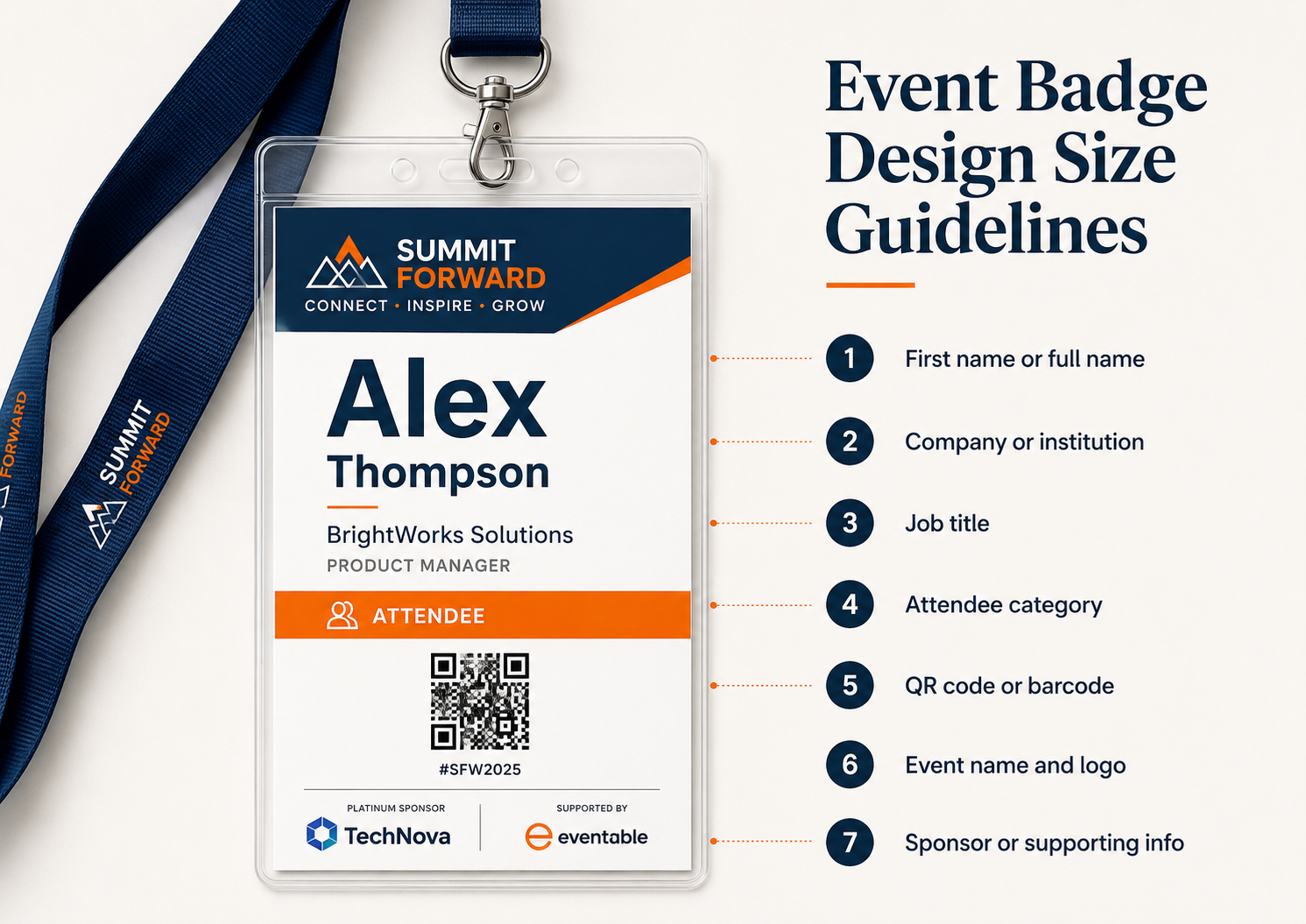
The greatest advantage of a professional insert workflow is personalization at scale.
One badge design can contain fixed elements such as the event logo, colors, or sponsor identity while attendee-specific fields change automatically.
ConferenceBadge supports attendee importing and variable data, including personalized names and multiple badge types. Its editor also supports logos, QR codes, barcodes, front-and-back layouts, and other custom elements.
That creates much more room for customizable credentials than simply typing a name into a template.
A typical professional insert might contain:
Attendee name
Company or organization
Job title
Attendee category
Event logo
Sponsor designation
QR code
Barcode
Table, group, or session assignment
Access designation
Not every event needs all of those fields.
In fact, adding them all is usually a mistake.
The person's name should generally remain the strongest element because the primary purpose of the credential is still human recognition.
A strange search phrase such as font event name tag ultimately reflects a real design problem: which font should an event name tag use?
The answer is a readable one.
The attendee should not need to stand still while someone deciphers their badge.
Typography, contrast, and spacing usually matter more than decorative complexity.
Full color does not mean fill every inch
Modern event badges can be printed in full color, which gives organizers substantial freedom to incorporate logos, backgrounds, role colors, sponsor graphics, and visual branding.
Freedom is not the same thing as an obligation to use every available area.
A conference badge should still look like identification first.
If the event logo takes up a third of the badge and forces the attendee's name into 12-point text, the visual priority is backward.
A better hierarchy might use a restrained event identity at the top, a large attendee name in the center, a company beneath it, and a clear role identifier near the bottom.
The back can carry secondary information.
ConferenceBadge's printed insert product supports front-and-back customization, which gives planners room to separate identification from schedules, sponsor information, QR functions, or other supporting material.
This is particularly valuable for multi-day events, where the badge remains in use long enough for secondary information to be genuinely useful.
Blank versus professionally printed name badge inserts
There is no reason every meeting needs professionally produced badges.
For a 20-person workshop, printing blank inserts internally may be the most rational choice.
Avery sells micro-perforated cardstock sheets designed for both laser printers and inkjet printers. Its common insert products can be customized and separated from standard 8.5 × 11-inch sheets before being placed inside compatible holders.
That workflow is familiar, inexpensive, and flexible.
The tradeoff is labor.
| Option | Best for | Benefits | Considerations |
|---|---|---|---|
| Blank inserts | Small meetings | Low upfront cost and flexible printing | Requires template setup, printing, and assembly |
| Pre-printed inserts | Conferences and large meetings | Consistent professional output with less manual work | Attendee data needs to be prepared |
| Hybrid | Events with late registrations | Most attendees can be prepared in advance while blanks handle exceptions | Requires an onsite process |
The tipping point is usually not a specific attendee count. It is complexity.
Avery name badge inserts versus ConferenceBadge
Avery and ConferenceBadge solve overlapping but different problems.
Avery makes strong sense when the event team wants a DIY office-printing workflow.
Its 5390 inserts are 2.25 × 3.5 inches, while its 5392 inserts are 3 × 4 inches. Both use micro-perforated sheets and can work with compatible office printers.
Avery also offers complete name badge kits combining inserts, holders, and in some cases lanyards, which can simplify small-scale event preparation. Its larger 6 × 4.25-inch kits can even include detachable ticket sections.
ConferenceBadge becomes more compelling when planners want the event workflow handled more centrally.
Its system supports attendee importing, badge printing software, multiple credential types, QR codes, professional event badge printing, printed holders and inserts, and onsite workflows for late attendees.
A planner preparing a departmental meeting for 35 people might reasonably choose Avery.
A planner preparing a national conference for 750 people may decide that saving several hours of printing, separating, assembling, sorting, and troubleshooting is more important than minimizing the cost of blank paper.
Neither choice is automatically better.
The event determines the right workflow.
What materials make the best name badge inserts?
Material choice determines whether the badge looks crisp on day one and still looks presentable on day three.
For inserts protected inside holders, heavyweight paper or cardstock is typically more useful than ordinary copy paper because it resists curling and shifting and provides a more substantial printed appearance.
ConferenceBadge currently prints its insert product on 10pt coated paper stock and places it inside vinyl holders.
Avery uses printable cardstock for many of its insert products, including versions designed for both laser and inkjet printers.
The holder adds another layer of protection.
Avery's heavy duty badge holders, for example, are reusable and designed for meetings, trade shows, seminars, and conventions.
The right material depends on the duration of the event.
A one-hour networking reception does not require the same durability as a four-day convention.
Similarly, a paper insert protected in a holder may be perfectly adequate indoors, while events expecting moisture or rough handling may benefit from more durable id cards, laminated credentials, or another format.
ConferenceBadge offers inserts and holders alongside cardboard badges and other badge formats, giving planners alternatives when inserts are not the right material
Are name badge inserts eco-friendly?
An eco-friendly badge strategy is not simply about choosing paper instead of plastic.
The full lifecycle matters.
A disposable plastic badge used once may create unnecessary waste. A durable holder reused across multiple annual meetings may have a very different lifecycle.
That is one reason insert-and-holder systems can be attractive to organizations that already own holders or intend to collect them after the event.
ConferenceBadge describes its vinyl holder format as easy to swap and reuse, particularly for multi-day events.
The practical sustainability decision is therefore often between:
Reusable holders with replaceable paper inserts
Single-use cardstock credentials
Durable plastic badges intended for longer service
Local PDF printing to reduce shipping, where practical
Planners should choose the format that matches how the event actually operates rather than assuming one material is universally more sustainable
Name badge inserts and holders should be treated as one product
A holder protects the insert, but it also determines how attendees interact with it.
Some name tag holders attach with a clip.
Others use lanyards.
Some can work with badge reels.
Others are designed for pinned or hanging credentials.
Avery sells both hanging and clip-style products, including reusable heavy-duty holders for longer events.
Attachment affects more than convenience.
If a holder constantly flips backward, the attendee name becomes invisible.
If a pin damages clothing, attendees may remove the badge.
If the lanyard is too long, the badge may sit at waist level and become difficult to read.
If the clip is too weak for a larger credential, it can rotate or fall.
This is why badge holders & inserts should be selected together rather than ordered as unrelated supplies.
The same logic applies to inserts holders badges as an event system: badge size, orientation, holder construction, attachment, and information layout have to work together.
Name badge inserts for conferences
Conferences are perhaps the most natural use case for insert-based credentials.
Attendees need identification, but planners often need to communicate additional roles.
A general attendee badge might show name and organization.
A speaker credential can clearly say SPEAKER.
A sponsor representative may need a sponsor label.
Staff badges may use a visually distinct treatment.
ConferenceBadge supports multiple badge types within its design workflow.
The ability to swap inserts is particularly useful for longer conferences because the holder remains usable even if the attendee information needs to change.
A three-day academic conference provides a good example.
An attendee arrives Thursday as a delegate.
Friday morning, she is replacing a panelist.
The event team can update the badge information without needing to replace the entire holder and lanyard setup.
That small amount of flexibility can prevent disproportionately awkward registration-desk situations
Name badge inserts for trade shows
A trade show places even more pressure on the badge.
The credential is not just identification.
It helps attendees understand who represents an exhibiting company, who is a sponsor, who belongs to staff, and who is simply attending the show.
Strong trade show badges can therefore contain category information in addition to the attendee name.
A trade show badge may show:
Name
Company
Job title
Exhibitor or attendee designation
Booth number
Sponsor status
QR code
Barcode
QR codes can be especially valuable when badges support lead retrieval for events.
ConferenceBadge's platform supports QR codes and barcodes, while its Lead Retrieval product allows exhibitors to scan attendee codes through a browser-based workflow.
The important point is that the QR code should serve a defined purpose.
Adding a QR code because badges are expected to have QR codes does not improve an event.
Connecting it to lead retrieval, check-in, attendee verification, or another specific process does.
QR codes for events need physical space
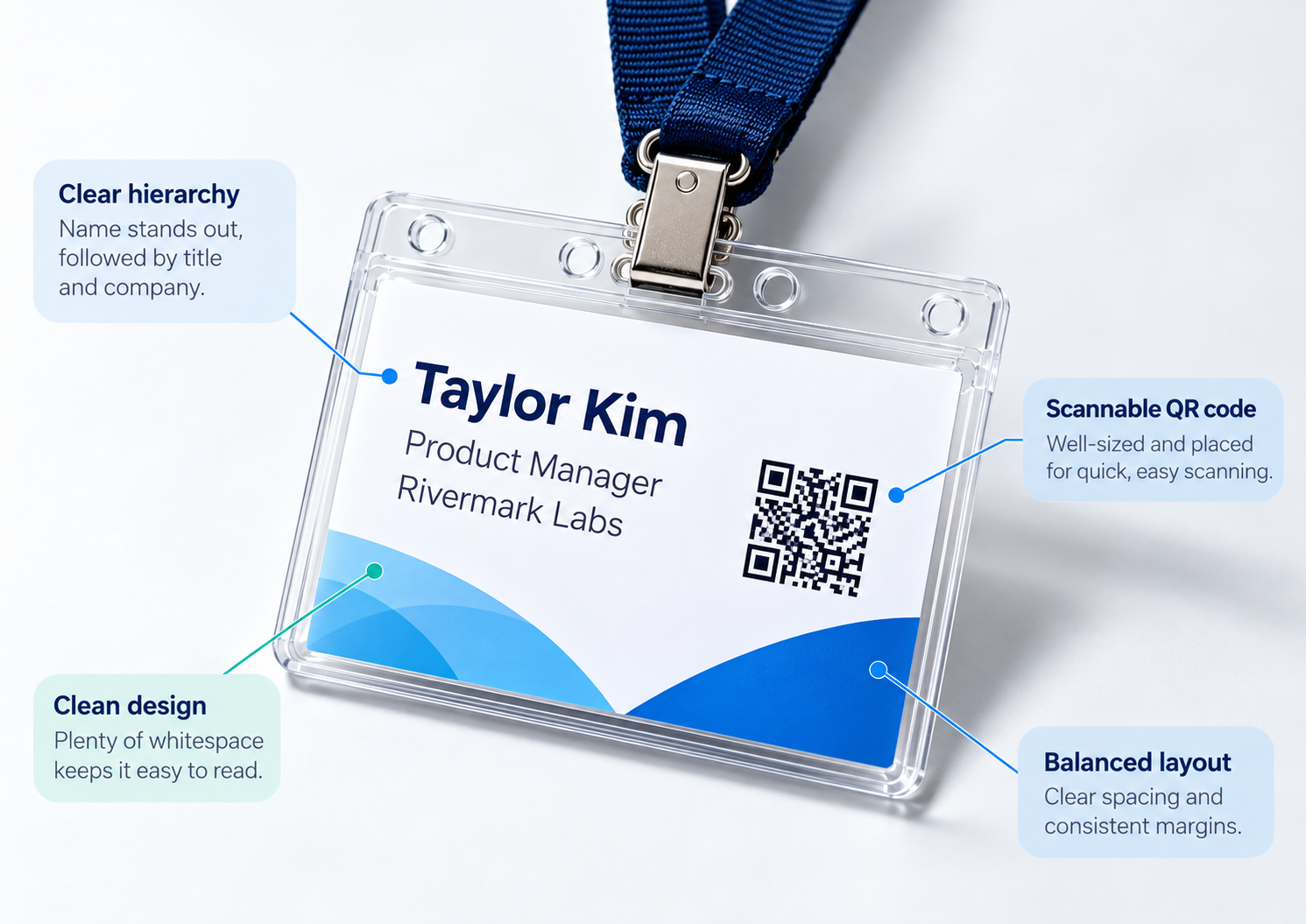
QR codes for events are often designed digitally first.
That is where problems begin.
A code that appears large on a laptop screen may become surprisingly small on the finished insert.
Cvent recommends associating each attendee QR code with a unique registration record when using QR check-in and supports QR codes as part of badge workflows.
The badge design therefore needs to reserve enough white space for the code.
Avoid placing text directly against it.
Avoid squeezing the code between logos.
And test it after printing.
This is one reason larger QR code event badges can be easier to design well. The planner does not have to choose between a readable name and a usable code.
Corporate event name badges need to look intentional
Internal events sometimes receive less badge-design attention because everyone technically works for the same organization.
Yet large corporate meetings can involve hundreds or thousands of employees who have never met.
At a sales kickoff, leadership summit, customer event, retreat, or training conference, Corporate Event Name Badges can still provide enormous networking value.
Someone might know the name of a coworker from Slack without recognizing them in person.
A well-designed insert bridges that gap.
Corporate credentials can also use department, office, territory, region, or attendee type as secondary information.
The mistake is turning the badge into an employee profile.
Keep the information that helps people connect.
Leave everything else in the app or registration platform.
Association and nonprofit meetings
Associations tend to have layers of identity that commercial meetings may not.
Someone can be a member, board member, sponsor, committee chair, speaker, exhibitor, first-time attendee, or several of those simultaneously.
The badge has to decide which distinctions deserve physical prominence.
This is where color and typography become useful.
A board role can be obvious without becoming visually dominant.
A sponsor can be recognized without obscuring the person's name.
The badge should reduce social ambiguity rather than create a legend attendees have to memorize.
Universities and academic events
Universities use name badge inserts across conferences, open houses, career fairs, alumni programs, research symposia, orientation programs, donor events, and departmental meetings.
These event use cases can require very different information.
A career fair may prioritize student, employer, and recruiter status.
An academic conference may emphasize institution and research role.
An alumni event may use graduation year.
A university event coordinator should therefore avoid treating a badge template as permanent.
The information should follow the purpose of the gathering.
Name badge inserts versus permanent ID cards
Temporary event credentials and permanent id cards may look similar, but they solve different problems.
An employee ID card might be expected to last years and support physical access or other identity systems.
A conference insert may only need to last three days.
That difference affects materials, cost, printing, and design.
If an event requires durable access credentials, an ID-card system may be more appropriate.
If the goal is short-term human identification, networking, and event categorization, reusable holders with replaceable inserts are often simpler.
The mistake is overengineering the credential.
Not every name badge needs to become a security card.
How attendee data becomes a printed insert
The actual production process starts long before paper reaches a printer.
Someone needs a clean source of attendee information.
For smaller events, that source might be a spreadsheet.
ConferenceBadge publishes guides for name badges from Excel and name badges from Google sheets, and its own production workflow supports spreadsheets and variable attendee data.
A basic file might contain:
First name
Last name
Company
Title
Attendee type
QR code value
The badge template then determines where those fields appear.
This is where badge integrations can become useful for events using registration systems rather than static spreadsheets.
The key is maintaining one reliable source of truth.
If one team is changing an Excel file while another updates badges independently in Microsoft Word, inconsistencies appear quickly.
A professional badge printing software workflow reduces that manual duplication.
DIY name tags using Microsoft Word
For smaller events, DIY name tags still have a place.
An event coordinator can create a template in Microsoft Word, connect a spreadsheet through mail merge, and print insert sheets through an office printer.
Avery's blank name badge products are designed around exactly this type of workflow. Its inserts are available in micro-perforated sheets compatible with both inkjet and laser printers.
This approach works best when:
The list is small
The design is simple
There are only one or two badge types
The printer is already tested
The team has time for assembly
It becomes less appealing as those variables change.
Imagine an HR conference that originally expects 80 attendees.
The team creates a Word template and everything works.
Then registration reaches 300.
Sponsors need their own design.
A QR code is added.
Speakers need a category label.
Thirty people register in the final three days.
The problem is not that Microsoft Word suddenly stopped working.
The event outgrew the workflow.
Why pre-printed inserts reduce event-week labor
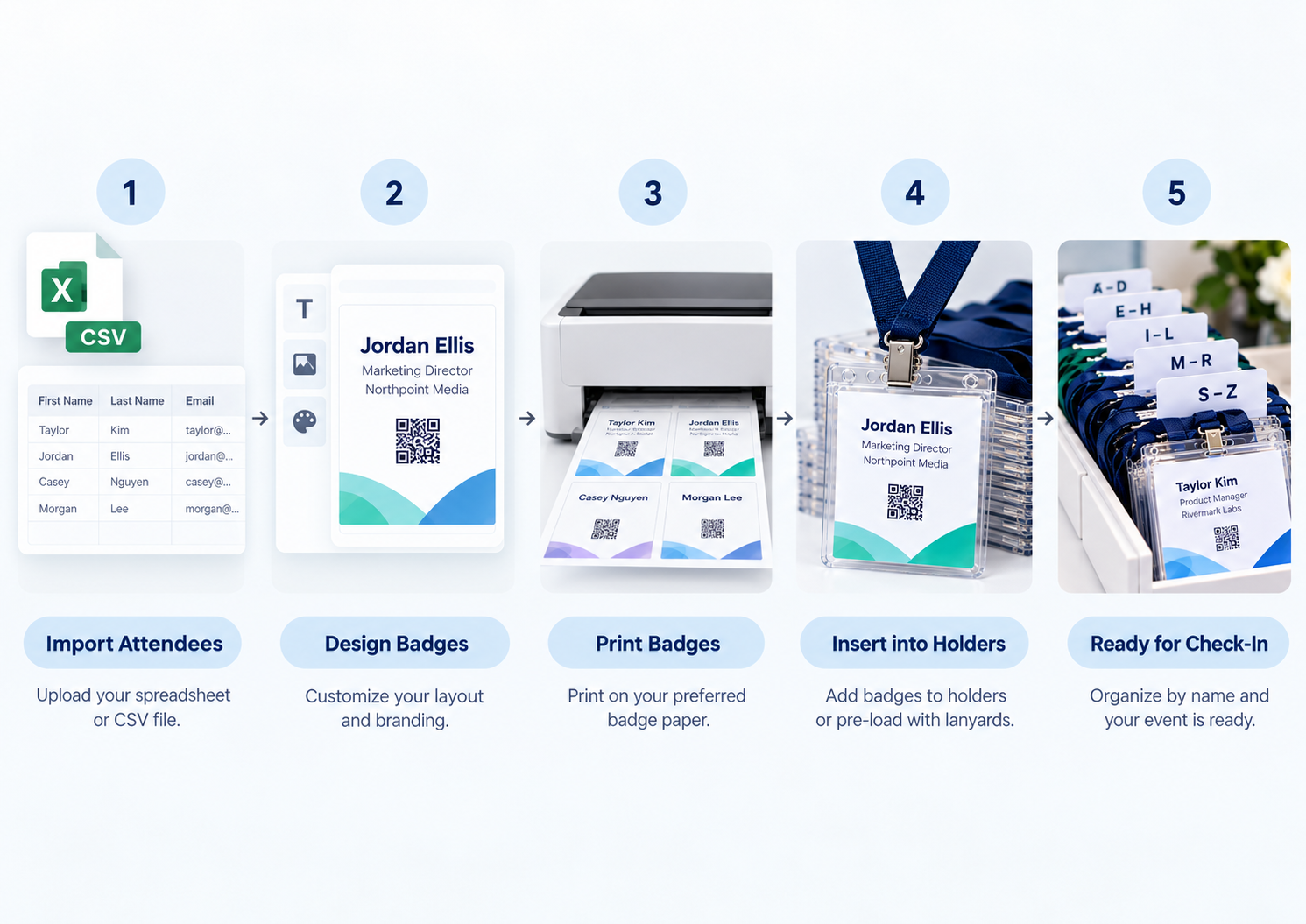
Pre-printed inserts shift work away from the most stressful part of the event timeline.
Instead of spending the final days printing sheets, separating inserts, placing them into holders, and troubleshooting alignment, the event team can focus on check-in logistics, speaker coordination, venue setup, and attendee communications.
ConferenceBadge's printed insert product arrives printed, cut, and pre-loaded into holders.
That is a small product detail with a large operational implication.
Consider 1,000 badges.
If each badge requires only 20 seconds to separate, inspect, insert into a holder, and organize, that represents more than five hours of continuous manual assembly before accounting for mistakes, sorting, or interruptions.
The event team does not merely buy printing.
It buys back staff time.
One thing that drives me nuts is constantly underestimating how long badge assembly takes for a 1000+ event. Cutting, matching, inserting, aligning and sorting can take multiple business days if there are only one or two people working on it. Also, this doesn’t take into account; correcting mistakes or last minute touchups. This is why getting a company that can digital assembly and QA your badges actually saves you money.
Amanda Collett, CEO of Conferencebadge.com
On site printing works best as an exception strategy
Even the best pre-event workflow cannot predict every attendee.
Someone registered late.
Someone loses a badge.
The title changes.
A name is spelled incorrectly.
This is where On site printing becomes useful.
ConferenceBadge's current onsite workflow is designed for last-minute attendees, walk-ins, and typo corrections and can work with consumer-grade printers.
For many events, a hybrid model works particularly well.
Print the majority of badges professionally before the event.
Then keep a smaller amount of blank media and printing capacity onsite.
Instead of making all 800 attendees wait for badges to print at registration, the system only handles the 20 or 30 exceptions.
That reduces both check-in friction and wasted printing.
Why reusable holders change the cost equation
A holder may cost more than a disposable sticker-style name badge label, but that comparison can be misleading.
A reusable holder can serve several events.
The insert is the disposable or replaceable element.
This works particularly well for organizations that host frequent internal meetings, university programs, association conferences, or training events.
Collect the holders at the end.
Replace the inserts next time.
ConferenceBadge positions its vinyl holders as reusable, particularly for multi-day event environments.
The economics become less attractive if the organization never collects them.
So the event workflow matters again.
Reusable does not automatically mean reused.
Name tag inserts versus name badge labels

Adhesive labels are simple.
That is their advantage.
For a short meeting, reception, classroom gathering, or casual networking session, a stick-on name badge label may be enough.
A holder-and-insert system becomes more useful when the badge needs to remain presentable for hours or days.
The holder protects the credential.
The lanyard keeps it visible.
The insert can carry more structured event information.
Neither format is universally better.
The decision should reflect how long attendees will wear the credential and how much information it has to carry.
Event badge printing should start with proofing
The most expensive badge error is the one repeated hundreds of times.
That is why event badge printing should never move directly from template creation to full production without proofing.
Test the longest name.
Test the longest company.
Test every badge category.
Test the QR code.
Test the back.
Test a badge with a missing title.
Print one.
Put it inside the actual holder.
Attach the actual lanyard.
Then have someone wear it.
Cvent similarly recommends avoiding overcrowded badges and maintaining readability, especially where QR-based functionality is also present.
This physical proof catches problems that a PDF cannot.
PDF badges provide another option
Some planners prefer to control printing locally.
ConferenceBadge offers PDF badges as part of its broader badge workflow, and its own event badge guidance discusses using PDF formats when organizers want to print internally.
This can work especially well when:
The organization has reliable local printing
Shipping is impractical
Attendee data changes very late
The event takes place outside a supported printed-badge region
Existing Avery or other holder stock is already available
The tradeoff is responsibility.
The organizer now owns printer scaling, paper choice, alignment, cutting or perforation, ink quality, assembly, and troubleshooting.
A downloadable file transfers printing control to the event team.
It also transfers printing risk.
Comparing name badge inserts with other conference badge alternatives

Conference badge alternatives include much more than paper inserts.
Depending on the event, planners may choose:
Adhesive name tags
Name badge inserts with holders
Cardboard Badges
Laminated badges
PVC credentials
Printed PDF badges
Digital credentials
On-demand event badges
The correct choice depends on the role of the badge.
A networking meeting benefits from readability.
A multi-day conference benefits from durability.
A trade show may prioritize QR-based lead retrieval.
A corporate meeting may prioritize branding.
A university conference may prioritize role distinctions.
ConferenceBadge provides multiple product options rather than requiring every event to use the same badge format.
That makes product selection part of event design.
How to order name badge inserts from ConferenceBadge
The ordering process becomes easier when planners separate badge structure from final attendee names.
Choose the insert and holder format
Start with the physical size.
ConferenceBadge currently offers 4 × 3 and 6 × 4 printed insert-and-holder formats. Decide how much information is needed and how far away the attendee name should remain readable.
Prepare attendee information
Organize names, companies, titles, roles, and other variable fields. Do this early even if registration is still open. The structure can be finalized before the final attendee list exists.
Create the custom design
Add event branding, attendee fields, colors, categories, QR codes, or barcodes as required. ConferenceBadge supports customizable front-and-back layouts.
Review the badge proof
Do not simply check whether the logo is correct.
Check real attendee records.
Long names and unusual titles reveal layout problems that placeholders do not.
Move to production
ConferenceBadge prints, cuts, and pre-loads the inserts into holders. Fast two-business-day turnaround is currently advertised as available for this product, with delivery across the USA and Canada.
Why choose ConferenceBadge for name badge inserts?
The advantage is not that paper inserts are difficult to buy.
They are not.
The advantage is connecting the insert to the broader event badge workflow.
ConferenceBadge combines attendee importing, custom designs, multiple credential types, QR codes, barcodes, printed badges, holders, lanyards, PDF options, and onsite printing capabilities.
That becomes more valuable as an event grows.
A planner no longer needs one supplier for inserts, another for holders, a Word template for personalization, a separate QR generator, a printing vendor, and an afternoon of staff labor for assembly.
The goal is not more sophisticated badge technology.
There are fewer opportunities for the process to break.
The best events I’ve seen are exactly the ones that can match simplicity with practicality. If it’s a small conference of less than 1000 people; you may not need different badge types, holders or lanyards. The more steps in the badge creation and assembly process, the higher the chance of mistakes or even failure. At a recent event I saw, there were actually two QR codes on their conference badges. This was an absolute disaster for not just check-in, but during social hour.
Amanda Collett, CEO of Conferencebadge.com
Name badge insert checklist
Most badge problems can be prevented before the print order is placed.
For larger events, it helps to review the following in one pass:
Confirm attendee count
Choose insert dimensions
Match the insert with the holder
Confirm horizontal or vertical orientation
Choose lanyard, clip, pin, or other attachment
Decide between blank and custom printed inserts
Prepare attendee data
Check first and last names
Review companies and job titles
Confirm attendee categories
Add QR codes or barcodes if needed
Test scanability
Review front-and-back designs
Order extra inserts for corrections
Prepare an onsite reprint process
Confirm badge assembly responsibilities
Sort completed badges before registration
A checklist is useful because name badge failures rarely come from one dramatic error.
They come from several tiny assumptions made by different people.
Frequently asked questions about name badge inserts
What are name badge inserts?
Name badge inserts are printed or printable cards that slide into badge holders and display information such as an attendee's name, organization, title, event role, QR code, barcode, or event branding.
They are particularly useful for conferences, meetings, trade shows, and other temporary events because the insert can be replaced while the holder remains reusable.
What size are name badge inserts?
There is no single universal size.
Avery offers common insert formats including 2.25 × 3.5 inches and 3 × 4 inches.
ConferenceBadge currently offers 4 × 3-inch and 6 × 4-inch printed inserts inside matching vinyl holders.
Always match the exact insert dimensions and orientation with the holder before ordering.
Can ConferenceBadge print custom name badge inserts?
Yes. ConferenceBadge's current inserts-and-holders product supports custom front-and-back designs, attendee information, logos, colors, schedules, and QR codes.
The broader ConferenceBadge platform also supports attendee importing, multiple badge types, QR codes, and barcodes.
Do name badge inserts come with holders?
ConferenceBadge's printed name badge insert product currently includes vinyl holders, and the inserts are printed, cut, and pre-loaded into those holders before shipment.
This differs from many DIY refill products. Avery, for example, sells certain insert refill packs separately from compatible holders.
Can I print name badge inserts from Excel?
Yes.
Event teams commonly create Name badges from Excel by using attendee spreadsheets with mail merge, badge templates, or specialized event badge software. ConferenceBadge also supports spreadsheet-based attendee data within its workflow.
For a small event, Excel and Microsoft Word may be sufficient. For larger events, dedicated badge software can reduce repetitive formatting and assembly.
Can I create name badges from Google Sheets?
Yes.
A Google Sheets attendee list can be exported or used as the source for a badge workflow. ConferenceBadge currently publishes a dedicated guide to Name badges from Google sheets as part of its event badge resources.
The same principle applies as Excel: clean, structured attendee fields make badge creation easier.
Should I use blank or custom printed badge inserts?
Blank inserts work well when the attendee count is low, the event team already owns compatible holders, and someone is comfortable managing printing.
Custom printed inserts become more attractive when an event has hundreds of attendees, multiple badge categories, branded designs, QR codes, or limited staff time before the event.
A hybrid workflow can also work well: pre-print known attendees and keep blank stock available for late changes.
Can name badge inserts include QR codes?
Yes.
ConferenceBadge supports QR codes on its customizable insert-and-holder product and across its broader badge platform.
QR codes can support check-in, attendee verification, networking, or Lead Retrieval for events. Test the final printed code before production rather than relying solely on the digital proof.
What are the best materials for printing durable and professional-looking name badge inserts?
For a professional insert placed inside a holder, a heavier paper or cardstock generally performs better than ordinary copier paper because it stays flatter, feels more substantial, and is less likely to shift or curl.
ConferenceBadge currently uses 10pt coated paper stock for its printed inserts and protects them inside vinyl holders.
For in-house printing, Avery uses printable cardstock in many of its insert products. Its 3 × 4-inch insert sheets are micro-perforated for clean separation and designed for both laser and inkjet printers.
The best choice depends on event duration. A short meeting may only require basic cardstock. A multi-day conference benefits from a stronger insert paired with a reusable holder. For events requiring greater resistance to water or wear, a more durable badge format may be preferable to a paper insert.
Name badge inserts are small, but they shape a surprisingly large part of the event
The strongest event operations are often invisible.
An attendee walks to registration.
Their badge is there.
Their name is spelled correctly.
The insert fits the holder.
The role is clear.
The QR code scans.
The lanyard hangs properly.
They put it on and walk inside.
Nothing about that interaction feels remarkable.
That is the point.
The badge only becomes noticeable when something goes wrong.
For small meetings, a blank Avery insert, office printer, and reusable holder may be all an organizer needs. For larger conferences and trade shows, professionally produced name tag inserts can remove printing, alignment, cutting, assembly, and data-management work from an already busy event team.
ConferenceBadge is designed around that larger workflow.
Instead of thinking only about the insert, planners can coordinate attendee information, custom event badges, holders, QR codes for events, Event badge printing, Badge Printing Software, lanyards, On site printing, and related badge products through one event-focused system.
