
Corporate Event Name Badges for Meetings, Conferences, and Company Events
Quick summary: Corporate Event Name Badges do more than tell people who is in the room. A well-designed badge helps attendees check in faster, recognize one another, understand roles, navigate access requirements, and start conversations without unnecessary friction. The right badge may be a simple printed insert for a leadership meeting, a large full color badge for a conference, or a QR-enabled credential connected to lead retrieval and attendee data. ConferenceBadge helps event teams create custom printed badges, PDF badges, Cardboard Badges, Name badge inserts, badge holders, lanyards, QR Code Event Badges, and on site printing workflows for everything from small company meetings to large corporate conferences.
Explore ConferenceBadge badge options.
The corporate event badge is easy to underestimate.
It is usually one of the smallest physical objects an attendee receives, but it may be used more often than almost anything else during the event.
An attendee picks it up at registration. Someone reads it while deciding whether to introduce themselves. Staff use it to distinguish a speaker from an exhibitor. An access team may use it to confirm that someone belongs in a particular room. An exhibitor may scan its QR code after a conversation. By the second day of a conference, the badge has become part identification, part networking tool, part event guide, and part operational infrastructure.
That is why Corporate Event Name Badges should not be treated as a final printing task.
They should be designed around what people need to do once they arrive.
A leadership summit involving 70 executives has a very different badge requirement from a three-day technology convention with 4,000 attendees, 80 sponsors, restricted sessions, and an expo hall. Both need name badges, but the similarities may end there.
The useful question is not simply, "What should our badges look like?"
It is: What does this badge need to help the event accomplish?
Corporate Event Badge Products from ConferenceBadge

Corporate events rarely have one universal badge format. A planner might need professionally printed conference badges for the majority of attendees, printable credentials for late registrations, lanyards for easy visibility, and a small supply of blanks for last-minute corrections.
ConferenceBadge offers several ways to build that workflow.
Custom printed event badges
Pre-printed badges work well when the attendee list is reasonably stable and the event team wants the credentials to arrive ready for registration.
ConferenceBadge's Cardboard Badges are printed double-sided on 16pt coated card stock and arrive pre-punched for lanyards. The format removes the need for plastic holders while still providing enough room for attendee names, branding, QR codes, and secondary event information.
They are particularly useful for conferences, sales kickoffs, corporate retreats, and other events where the badge needs to feel more substantial than a temporary office name tag.
PDF badges
PDF badges give organizers more control over where and when production happens.
The organizer creates a badge design, imports attendee data, generates the badges, and receives a print-ready PDF. Those files can then be printed through an office printer, commercial print shop, Avery-compatible workflow, or venue setup.
This can be especially useful for international events, seminars with short timelines, or organizations that already have reliable local printing resources. ConferenceBadge currently supports custom badge dimensions as well as standard formats.
Name badge inserts and holders
Name badge inserts remain useful because they separate the printed information from the physical holder.
The insert can change while the holder remains reusable.
That makes inserts and plastic holders practical for multi-day events, recurring meetings, university programs, conventions, and organizations that want to collect the holders afterward.
ConferenceBadge's current insert-and-holder system includes printed inserts that arrive cut and already loaded into vinyl holders.
Laminated PVC badges
Some events need something more durable.
Plastic name badges and larger PVC credentials can be useful when an event runs for several days, takes place partially outdoors, requires a more premium finish, or uses credentials beyond a single meeting.
This is closer to the durability people associate with id cards while retaining the larger format used for event identification.
Lanyards
The lanyard is not merely an accessory.
It determines where the badge sits, how easily it can be seen, whether it flips around, and whether attendees continue wearing it as the event progresses.
ConferenceBadge offers standard black lanyards as well as custom lanyards that can include different colors, company branding, or attachment configurations.
On site printing
No attendee list stays perfect.
Someone registered late. A job title changes. A speaker brings a colleague. An executive's name is misspelled. A guest loses their badge.
A reliable on site printing workflow gives the registration team a controlled way to deal with those exceptions without reaching for a marker and a blank adhesive label.
ConferenceBadge's Print Center creates badges through a browser and generates print-ready PDFs that can be sent to a consumer-grade printer at the event.
That matters because the quality of the exceptions contributes to the quality of the event.
The 500 pre-printed badges may be perfect, but the attendee does not care about those 500 if theirs is the one being rewritten by hand at the registration desk.
A question for Amanda: Think of an event where most of the badges were already prepared but one unexpected group arrived, an attendee's information changed, or a typo needed to be fixed onsite. What did the registration team have to do, and how did the presence or absence of a backup printing process affect the line?
"One thing we see all the time is that the attendee list is never quite as final as everyone hopes it will be. One thing we see is that attendee lists are never finalized, especially at the onset of registration. Even if 95% of the badges are ready to go, there's always an issue -- and these issues are what will test your registration process. If you can use something simple like a Sharpie or Name-tag, or have default blank nametags templated, these are usually good (as long as people are okay with it looking less professional). So, when we do badge planning; we typically try to think of backup strategies as contingencies as the same process. "
Why Corporate Event Name Badges Matter

A badge begins doing its job before someone reads every word on it.
At check-in, an organized set of badges signals that the event team knows who is coming.
Five minutes later, the same badge begins supporting networking.
Later in the day, its role may change again.
Staff might use role categories to identify speakers. Security may look for a credential color before allowing access to a private session. Exhibitors may scan qr codes. Attendees may look at job titles before deciding whether someone is relevant to a conversation.
Cvent similarly describes conference badges as tools for identification, networking, branding, check-in, and event operations, particularly when barcodes, QR codes, or other identifiers are incorporated into the credential.
The usefulness comes from reducing tiny moments of uncertainty.
Imagine arriving at a corporate leadership summit.
There are 180 people in the reception area. You recognize some faces but not others. You know the organization has brought together directors from several regions, external partners, and members of the executive team.
A readable badge gives you context in a second.
ALEX MARTINEZ
Vice President, Operations
Northwest Region
You no longer need to open with, "Sorry, what was your name again?"
That seems minor until the purpose of the entire event is connection.
Multiply the same moment across several hundred attendees and thousands of conversations, and readability becomes part of the networking experience.
Bad badges create invisible friction
Poor badges rarely cause an event to collapse.
Instead, they create small problems everywhere.
Names are too small to read.
The company logo is larger than the attendee's name.
The badge holder rotates backward.
Someone's title runs onto four lines.
A dark background makes the QR code unreliable.
The lanyard places the badge too low.
A VIP designation is so subtle that staff cannot identify it.
A QR code is tied to the wrong attendee record.
None of those failures looks catastrophic in the design file.
They become obvious once people start using the badge.
That is why a badge should be tested as an object people will wear, not simply reviewed as artwork on a screen.
Corporate Event Badge Use Cases
There is no single "corporate event."
Even within one company, different gatherings create very different badge requirements.
Corporate conferences
A corporate conference may bring together hundreds or thousands of employees, customers, partners, sponsors, speakers, and exhibitors.
The badge has to communicate quickly.
Names need to be readable. Attendee types need to be recognizable. Sponsor logos may need visibility without overpowering attendee information. QR codes for events may support session access, networking, or lead Retrieval for events.
The larger the event becomes, the more important consistent attendee data and badge production become.
Sales kickoffs
An SKO is often built around internal networking as much as presentations.
People who normally interact through Slack, Teams, Zoom, or email finally meet in person.
That makes names, departments, territories, and job titles genuinely useful.
Instead of treating every badge as identical, a sales kickoff might display region, sales role, product team, or another field that helps employees understand how the organization fits together.
Leadership summits
Leadership events often require less information.
If 50 executives are spending two days together, a large six-inch badge containing five fields may be unnecessary.
A restrained badge with the attendee's name, position, organization, and perhaps event branding is often enough.
The badge should match the intimacy of the room.
Company retreats
A retreat creates an interesting tradeoff.
The atmosphere is deliberately less formal, but people may still be meeting colleagues for the first time.
Name tags can reduce awkwardness during the opening sessions without making the retreat feel like a trade show.
The answer may be a lighter, simpler custom badge rather than abandoning badges altogether.
Training events
Training programs often benefit from adding department, cohort, session group, certification track, or table assignment.
Here, the badge becomes an organizational tool.
The same principle applies to university deans coordinating faculty events, orientation programs, research conferences, and academic seminars.
Client and partner events
Client events demand particularly careful branding.
The credential is a physical representation of the host organization, but it should still prioritize the attendee.
Full color printing can create a polished brand experience without turning the badge into an advertisement.
Networking events
Networking is where readable names matter most.
If the purpose is to help people meet, the design should optimize for recognition from several feet away.
A beautiful badge that requires close inspection has failed its primary use case.
Trade shows and conventions
Trade Show Badges often have to do much more.
Attendees, exhibitors, media, staff, speakers, contractors, and sponsors may each require different visual treatment.
The badge may also connect to Lead Retrieval for events, access control, session tracking, or exhibitor systems.
These Event use cases make larger formats and structured attendee data much more valuable.
A question for Amanda: Describe the moment at a large conference when you noticed how many different credential types were moving through the same registration area. Attendees, VIPs, speakers, exhibitors, staff, media, or sponsors are ideal examples. What did that reveal about badges as an operational tool?
"At big conferences, people honestly don’t look at names, their first thing to look at is their role in the conference. Whether your an attendee, speaker, sponsor, exhibitor, staff or VIP; that will set the tone of the interactions. The purpose of a badge is to make it easy for people to engage with each other and their environment at a conference."
What to Include on Corporate Name Badges

Every available field does not belong on the badge.
That sounds obvious, but modern Badge Printing Software makes adding information so easy that over-design becomes tempting.
A registration system might contain 20 pieces of attendee information.
The badge probably needs four.
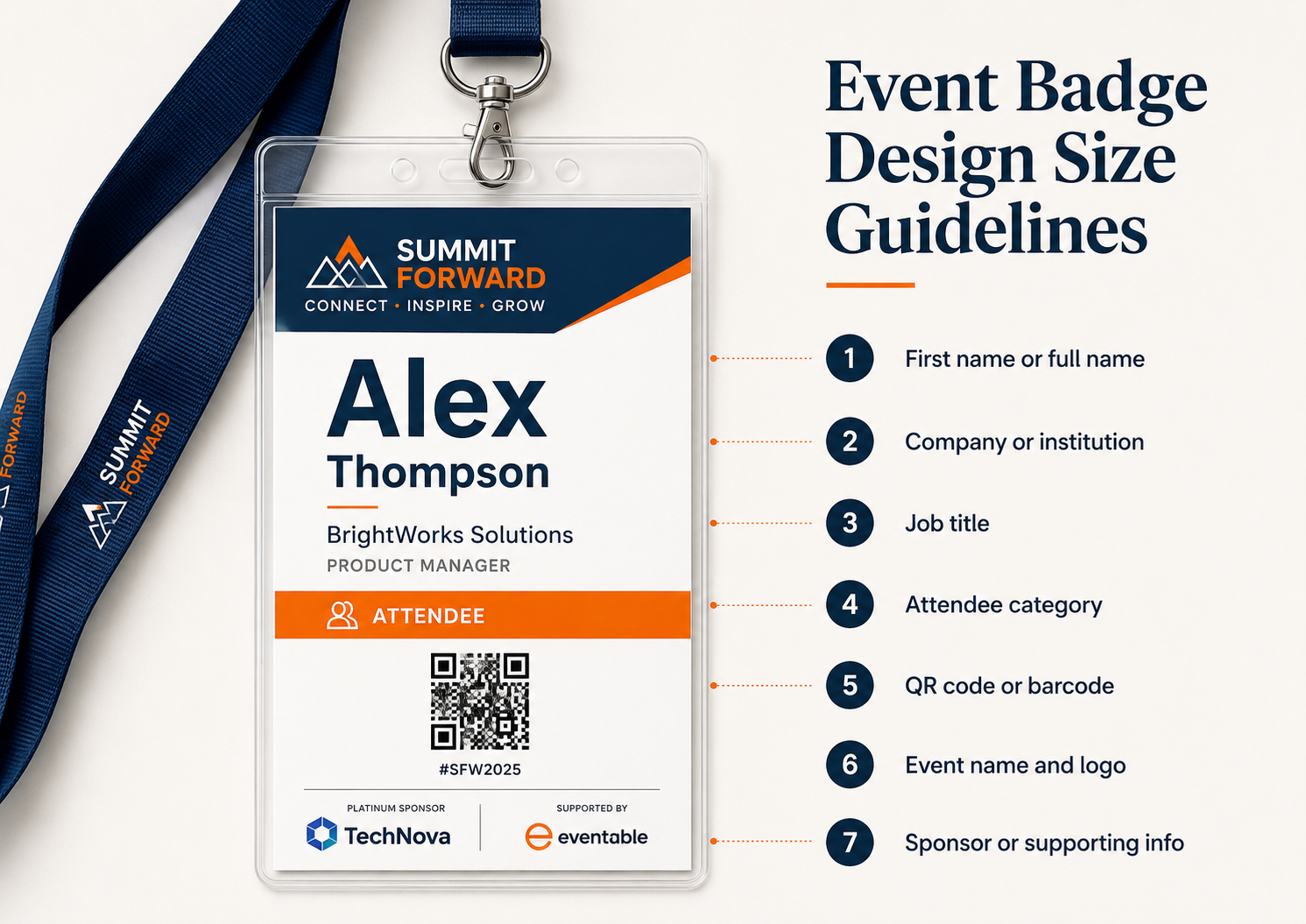
A useful hierarchy commonly starts with:
Attendee name
Company or organization
Job title or department
Attendee type when operationally useful
Event name or company logo
QR code or barcode when it serves a defined workflow
Sponsor designation when relevant
Table number, session group, or access level where needed
The attendee names should usually be the most prominent part.
A person approaching from eight feet away is trying to determine who they are speaking with, not admire the event identity system.
That is also why the odd search phrase Font event name tag points to a legitimate problem.
Which font should an event name tag use?
The answer is not necessarily the most interesting font.
It is the one people can read.
Use branding as context, not competition
Corporate branding still matters.
A company logo can make the badge feel intentional and reinforce which organization is hosting the event.
Sponsor logos may also be commercially important.
But visual hierarchy matters more.
If the sponsor identity takes up half of the credential while the person's name is squeezed beneath it, the badge has stopped prioritizing the attendee.
A useful pattern is:
Event identity near the top.
Large attendee name through the center.
Company and job title underneath.
Role or access information in a controlled location.
QR code near the bottom with enough clear space to scan reliably.
Secondary information on the back.
This also gives the badge room to breathe.
QR codes need a job
Adding a QR code because QR codes are popular is not an event strategy.
The organizer should know what happens after it is scanned.
That may include:
Check-in
Session entry
Contact exchange
Lead Retrieval for events
Event app access
A personal attendee profile
A schedule
A feedback form
Cvent notes that QR-based event workflows can connect attendees to registration IDs, URLs, or other information used for check-in and related event activities. Our own experience with QR codes vary as well, feel free to read on.
The critical distinction is between a shared QR code and a unique one.
A shared event-app code can be repeated on every badge.
A unique attendee code must remain associated with the correct person.
That means data accuracy becomes part of badge quality.
Barcodes can serve the same operational layer
Barcodes may make more sense when the event already uses hardware or systems designed around them.
Visual technology is less important than compatibility with the event workflow.
The mistake is designing the physical badge first and discovering afterward that the scanners, registration platform, badge integrations, or access system require something different.
The Badge Should Match the Conference Room Layout
Badge design changes when the physical environment changes.
Consider a small boardroom.
Twenty-four attendees spend most of the day sitting around a U-shaped table. They are rarely more than a few feet apart.
A modest badge can work perfectly.
Now move the same organization into a convention center.
People are moving through wide corridors, standing in clusters, approaching exhibit booths, and talking over background noise.
Suddenly, reading a small badge becomes difficult.
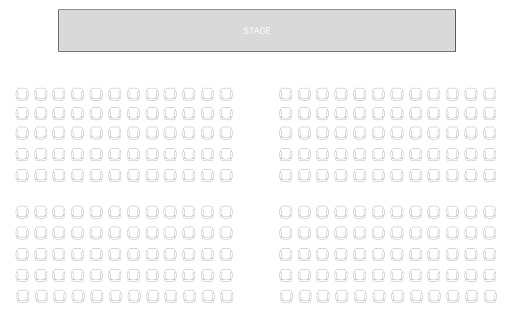
That is why conference room layout and badge design should be considered together.
A larger badge is not automatically better.
It simply gives the organizer more visual space when the event environment demands it.
ConferenceBadge supports several event badge sizes, including 4 by 3-inch inserts, larger 6 by 4-inch options, cardboard formats, and custom PDF dimensions.
For networking-heavy conferences, larger formats often give attendee names enough space to remain legible while still accommodating company, role information, and scanning technology.
A question to Amanda: Think about two contrasting events you have seen. One could be a small leadership meeting and the other a large conference or expo. What information needed to be visible in each environment?'
"If it’s small leadership meeting, you can run to Walmart and buy name tags; no need for lanyards — stickers will do. If you’re at an actual conference with 100+ people and they are from different companies, departments; badges with Name, position, company (or department) and perhaps a QR code for the company director or LinkedIN is always useful."
Choosing the Right Badge Size
There is no universal standard event badge that works for every gathering.
A compact badge size makes sense when the information is limited.
A larger badge makes sense when readability or additional functions matter more.
For example, a 3 by 4-inch style can work well for straightforward identification.
A 4 by 6-inch credential creates considerably more room for large names, event roles, qr codes, sponsor information, or useful content on the reverse side.
The key is to work backward from the information.
If the badge needs:
Name
Company
Job title
Attendee category
QR code
Sponsor status
Access level
then attempting to compress everything onto a small format creates a predictable problem.
The organizer either removes information or makes everything smaller.
Larger badges give the hierarchy room to work.
Custom Badges, Inserts, Holders, Lanyards, and QR Codes
The badge itself is only one piece of the credential.
A corporate badge system may include custom event badges, printed inserts, plastic holders, lanyards, scanning technology, and spare materials for onsite changes.
These elements should be selected together.
Inserts and holders
An insert-and-holder system works particularly well when the organization wants a protected paper badge and plans to reuse the holders.
The holder gives the badge structure and durability.
The insert provides the personalized information.
For multi-day events, that separation can be useful because damaged or incorrect inserts can be replaced without discarding the entire holder.
ConferenceBadge offers Name badge inserts in matching vinyl holders, with current printed sizes including 4 by 3 inches and 6 by 4 inches.
Search terminology around these products is not always elegant. Planners may search for Inserts holders badges, Name badge outs, badge holder refills, or printable conference inserts while looking for essentially the same workflow.
The important part is confirming compatibility before production.
Lanyards versus clips, pins, and magnetic attachments
Lanyards work particularly well for larger conference badges because the attendee does not have to attach anything directly to clothing.
A clip or pin can make sense for smaller name tags.
A magnetic backing is another common choice for reusable corporate name tags because it avoids puncturing a shirt or jacket, although it serves a different purpose from a large hanging event credential.
The attachment should follow the format.
A 6 by 4-inch event credential is typically better suited to a lanyard than a small magnetic backing.
Plastic holders versus holder-free badges
Plastic holders provide protection and can be reused.
Holder-free Cardboard Badges reduce the number of components and eliminate the need to load a card into a sleeve.
Neither is automatically correct.
A university running the same orientation series every semester might value reusable holders.
A one-day conference might prefer printed card stock that arrives ready for a lanyard.
The question is how the badge will actually be used.
Event badges & passes that support access
Some events need identification.
Others need credentials.
Once a badge begins controlling entry into VIP lounges, breakout rooms, backstage areas, private workshops, or employee-only spaces, access control becomes part of the design.
The organizer may introduce:
Role colors
Printed access levels
QR codes
Barcodes
Security features
Numbered credentials
Visually distinct attendee categories
Do not make these distinctions so subtle that staff need to inspect every badge closely.
The goal is to help authorized staff make quick decisions without creating unnecessary friction for attendees.
Corporate Badge Data Starts Before the Badge Is Designed

Many badge problems are actually spreadsheet problems.
The event team discovers them only when it starts printing.
Suppose one attendee record says:
First Name: Christina
Last Name: Rodriguez
Company: Atlantic Bio
Title: VP, Clinical Operations
Another says:
Name: Mark Chen - Acme - Product
And another has a blank company field.
The design cannot fix inconsistent source data automatically.
It can only expose it.
This is where Name badges from Excel and Name badges from Google sheets become important.
For small events, the spreadsheet itself may be enough to manage attendee information.
As the event grows, it is generally better to treat Excel or Google Sheets as the structured data source and use badge software to control the visual layout.
ConferenceBadge publishes dedicated workflows for both:
The principle is simple.
One attendee per row.
One data field per column.
The badge template then determines where those fields appear.
ConferenceBadge's Badge Printing Software allows organizers to import attendee information and populate badge templates rather than creating hundreds of individual files manually.
A mini-case: when one spreadsheet becomes two sources of truth
Imagine a 500-person conference.
The registration team maintains the attendee list in Google Sheets.
Three days before the event, someone exports the sheet to Excel so badges can be produced.
Registrations continue.
A staff member updates the Google Sheet.
Another staff member corrects several titles in the Excel export.
Neither realizes the files have diverged.
On event morning, some badges reflect the newer registrations while others reflect the corrected titles.
Nothing went wrong with the printer.
The process failed earlier.
The useful lesson is to define a production source and cutoff point.
Once badge production begins, everyone should know which file controls the credential data.
Here is a question for Amanda: Has ConferenceBadge seen customers discover data-quality problems during badge preparation? Think about duplicate names, missing titles, last-minute exports, incorrect attendee categories, or different spreadsheet versions.
"I’ve lead and done badge creation / process for hundreds of conferences. It is a great place to uncover problems with attendee data. Whether that’s the layout of the badge, a name spelt wrong or an error in the data; it’s NEVER the same as what’s in Excel, Google sheet or whatever spreadsheet originally had the data. What still blows my mind to this day is, when those badges are all printed, you know the conference is real."
How the Corporate Badge Ordering Process Works
A good production workflow removes decisions from event week.
1. Choose the badge product
Start with the event itself.
Does the team need a pre-printed credential?
A reusable holder?
A downloadable PDF?
A more durable PVC badge?
Onsite flexibility?
The answer determines the production path.
ConferenceBadge's current product range can be reviewed at:
https://www.conferencebadge.com/products
2. Share the event details
Badge requirements become clearer when the organizer knows:
Estimated attendee count
Event length
Venue type
Registration process
Badge distribution method
Attendee categories
Whether attendees need access distinctions
Whether exhibitors need scanning
Whether late registrations are expected
3. Send attendee data
Prepare the attendee list before trying to perfect the design.
Confirm spelling.
Normalize company names.
Review long job titles.
Remove duplicates.
Identify speakers, sponsors, VIPs, exhibitors, staff, and guests.
This is also the time to create unique fields required for QR codes or badge integrations.
4. Review the proof
A digital proof should be reviewed as if it were a physical object.
Check the shortest attendee name.
Then the longest.
Check the longest company.
Check someone with a long title.
Check every credential type.
Check both sides.
Scan the QR code.
Make sure the sponsor logo does not overpower the attendee's identity.
Then print one at actual size if possible.
5. Receive event-ready badges and supplies
Pre-printed credentials should arrive organized enough that the registration team does not have to build the event again at the venue.
For large conferences, the final operational step is deciding how badges will be sorted and distributed.
Alphabetical order is common.
Large events may further separate VIPs, speakers, exhibitors, staff, or groups that use different check-in processes.
Corporate Event Badge Checklist
Badge projects become much easier when the decisions happen before production.
Before finalizing a corporate event order, confirm:
Final estimated attendee count
Badge size and orientation
Custom badges versus inserts and holders
Whether lanyards are required
Which fields appear on the badge
Attendee data source
VIP, speaker, staff, sponsor, exhibitor, and guest categories
QR codes or barcodes
Whether codes are shared or unique
Access control requirements
Front-and-back design
Proof approval
Shipping location and timeline
Extra badges or inserts
Late-registration plan
Onsite printer availability
Registration-desk layout
Backup supplies
This is less about creating paperwork and more about removing uncertainty.
Every decision made two weeks before the conference is one less decision the registration team has to make while 200 attendees are waiting.
DIY Name Tags Versus Professional Event Badge Printing
DIY name tags are not inherently a poor choice.
They are often exactly the right choice.
A department holding a 25-person training session can reasonably print simple badges from an office printer.
Buying specialized printed credentials may create more process than the event needs.
The equation changes as attendee count and complexity grow.
A 700-person corporate conference may require:
Multiple credential types
Individual attendee names
Custom branding
Sponsor logos
Different job titles
QR codes
Access categories
Double-sided printing
Last-minute updates
Sorting for registration
At that point, the DIY approach is no longer free.
The cost simply appears as staff time.
Someone has to configure the template.
Someone has to run the printer.
Someone has to separate the stock.
Someone has to load inserts into badge holders.
Someone has to organize them.
Someone has to troubleshoot misalignment.
Professional event badge printing transfers much of that production work out of event week.
The tipping point is not a magic attendee count.
It is complex.
Custom Event Badges Versus Permanent Employee Name Tags
A corporate event badge and a permanent employee name tag may contain similar information, but they solve different problems.
Small custom name tags made from metal or plastic are well suited to repeated daily use.
They may use a magnetic backing, clip, or pin and typically show a name, position, and company logo.
Large conference credentials are temporary.
They often require more visible attendee names, categories, qr codes, barcodes, sponsor information, or event-specific access.
That is why custom name tags & event badges should not automatically use the same format.
A permanent employee badge optimizes for durability.
A corporate conference badge optimizes for temporary identification, networking, and event operations.
QR Code Event Badges and Lead Retrieval

The badge becomes much more valuable when a scan carries context forward from the conversation.
Imagine an exhibitor meeting 60 prospects during a trade show.
Without lead capture, the representative collects business cards, takes occasional notes, and hopes the conversations remain memorable after three days of meetings.
With lead retrieval for events, a representative can scan the attendee's credential and attach notes while the discussion is still fresh.
ConferenceBadge's lead retrieval workflow supports scanning attendee badge QR codes through a phone browser and adding notes or tags to the captured lead.
The badge is no longer simply identifying the attendee.
It becomes the physical bridge between the conversation and the follow-up.
This is one reason QR Code Event Badges have become useful at trade shows and sponsor-driven events.
But scanning technology does not make a badly designed badge good.
The code still needs enough clear space.
The information encoded needs to be correct.
The exhibitor workflow needs to be understood.
And the event team needs to decide what happens with that data after the event.
A scan is only valuable when it improves the next action.
Conference Badge Alternatives: Choosing the Right Production Model
There are many Conference badge alternatives because there are many ways to produce identification.
For a small meeting, an office-supply badge kit may be enough.
Office Depot currently carries printable badge kits, clip-on holders, magnetic options, hanging name badges, and custom printed name-tag products.
Avery-style inserts are also practical for teams that already have an office printing workflow.
A permanent name-tag supplier may make more sense when the product needs to function as an employee badge for months or years.
ConferenceBadge fits a different need: producing event credentials around attendee data, variable badge information, multiple formats, QR workflows, professional printing, and onsite changes.
The better question is not "Which badge company is best?"
It is "Which workflow fits this event?"
Why Choose ConferenceBadge for Corporate Event Name Badges?
Corporate planners usually do not need more badge features.
They need fewer things to go wrong.
ConferenceBadge is designed around that operational reality.
Event teams can create credentials using attendee data rather than manually typing individual badges, choose from several physical formats, generate printable PDFs, order professionally printed credentials, incorporate QR codes or barcodes, and maintain an onsite workflow for exceptions.
Current options include:
PDF badges
Cardboard Badges
Name badge inserts and holders
Laminated PVC badges
Lanyards
On site printing
Variable attendee data
QR code and barcode fields
Full color printing
Multiple Event badge sizes
https://www.conferencebadge.com/products
More importantly, those products can operate as one badge workflow.
The attendee list becomes the source.
The design determines how that data appears.
The production method determines where the badge is printed.
The onsite process handles exceptions.
That is much more useful than thinking about badge printing as a task that begins after everything else is finished.
We asked Amanda this question related to above: What have you learned from customers who initially approach ConferenceBadge thinking they only need "badges," but discover that what they really need is a cleaner process for data, production, and event-day changes?
Her answer:
"Most conferences don’t need crazy fancy badge technology. We all just want registration to go smoothly. Right name, right badge, right code and some contingencies incase someone is late or their name is spelt wrong. This is especially important for speakers and exhibitors who are a core part of the conference. Technologies like QR codes and RFIDs should make things easier, not hard"
The Best Corporate Badge Is the One People Do Not Have to Think About
Successful event infrastructure tends to disappear.
An attendee should not need instructions for how to wear their badge.
A staff member should not need to squint to determine whether someone has access.
An exhibitor should not struggle to scan a QR code.
A registration employee should not spend three minutes rebuilding a credential because someone's title changed.
Everything simply works.
That is the real standard for Corporate Event Name Badges.
Not whether the design looked impressive in a presentation.
Not whether every available field was included.
Not whether the badge used the newest technology.
The test happens when hundreds of people begin moving through the event.
Can they check in?
Can they recognize each other?
Can staff understand roles?
Can sponsors interact with prospects?
Can late attendees receive a badge that looks like everyone else's?
Can the event team solve exceptions without creating a line?
When those answers are yes, a small printed credential has done a surprisingly large job.
Frequently Asked Questions About Corporate Event Name Badges
What are some good name tags for events?
Good event name tags are easy to read, comfortable to wear, and appropriate for the environment. Small meetings may only need printed inserts or simple custom name tags. Conferences and trade shows often benefit from larger conference badges with attendee names, company information, job titles, role categories, and optional QR codes. Multi-day events may benefit from protected inserts and badge holders, while one-day events may work well with holder-free card stock badges.
Can Office Depot make name badges?
Yes. Office Depot currently sells badge kits, holders, printable products, and several custom printed name-tag options. That can be practical for small meetings or permanent employee identification. Larger conferences with individualized attendee data, event-specific designs, unique QR codes, and production workflows may be better served by dedicated event badge software or professional Event badge printing.
What are some companies that make name badges?
Options include ConferenceBadge for event-focused badges and printing workflows, Avery for printable inserts and office badge kits, Office Depot for office and custom badge products, and companies such as Name Tag Pros for permanent or reusable custom name tags. The right supplier depends on whether you need temporary event credentials, reusable employee tags, DIY printing, or professionally produced conference badges.
Where can I print event name badges?
You can print badges through a commercial printer, office-supply provider, your own office printer, or an event badge provider. ConferenceBadge also offers PDF badges for self-printing, professionally printed credentials, and a browser-based on site printing workflow for late attendees and reprints.
https://www.conferencebadge.com/products/on-site-printing
What are the disadvantages of a corporation?
A corporation can involve more administrative requirements, formal governance, filings, recordkeeping, and potential costs than simpler business structures. The specific legal and tax tradeoffs vary by jurisdiction, so business owners should obtain advice appropriate to their location.
What is the meaning of the adjective "corporate"?
"Corporate" generally means relating to a corporation or company. In the context of corporate events, it usually describes meetings, conferences, retreats, trainings, celebrations, or other gatherings organized by or for a business.
What is the difference between a company and a corporation?
"Company" is a broad term for a business organization. A corporation is a specific legal form of business that generally exists as a legal entity separate from its owners. The exact legal implications depend on jurisdiction.
What size badge works best for conferences?
There is no universal best badge size. A smaller badge can work for meetings with limited information, while larger 4 by 6-inch formats can be helpful at networking-heavy conferences and trade shows where names need to remain visible from farther away. ConferenceBadge currently supports common formats including 4 by 3-inch and 6 by 4-inch credentials as well as custom PDF dimensions.
What types of name badges do you make?
ConferenceBadge currently offers PDF badges, printed Cardboard Badges, Name badge inserts with vinyl holders, laminated PVC badges, and onsite printing workflows. Lanyards can also be added to complete the credential setup.
https://www.conferencebadge.com/products
Why Order Event Name Tags From Name Tag Pros?
Name Tag Pros positions its event products around multiple sizes, plastic or metal materials, custom colors, logo customization, and attachment choices including magnetic, pin, clip, or clutch backings. Those products may make sense when an organization wants a smaller permanent or reusable name tag. For large temporary conferences that depend on attendee data, QR codes, variable credentials, lanyards, and onsite changes, planners should compare that workflow with an event-focused provider such as ConferenceBadge.
Can I print different names on each conference badge?
Yes. Variable attendee data allows one badge template to display different attendee names, companies, job titles, QR codes, barcodes, or categories for every person. ConferenceBadge supports importing attendee information so organizers do not have to create each badge manually.
How thick are Standard Event Badges?
There is no universal thickness for a standard event badge because material varies. ConferenceBadge's current cardboard format uses 16pt coated card stock, while its printed insert product uses 10pt coated paper inside a vinyl holder. PVC credentials use a different material entirely. Choose thickness based on the badge format, event duration, and whether a protective holder is being used.
What are custom event ID cards and conference badges used for?
Custom event id cards and conference badges can identify attendees, display roles, support networking, distinguish speakers or staff, display sponsor information, connect to access control, and carry QR codes or barcodes for check-in, session access, or lead capture. Their exact purpose should be determined before the badge is designed.
How can I design effective name badges for a corporate event?
Start with the attendee rather than the branding. Make the attendee's name the dominant element, choose a readable font, keep company and job information secondary, limit decorative clutter, and include QR codes or access information only when they support a real workflow. Then print and wear a test badge before approving production.
How can I design custom corporate event name badges?
First determine the badge's purpose and physical format. Choose the badge size, decide what attendee information is required, create a clear visual hierarchy, add the company logo and event branding, and map variable attendee data into the design. Test long names, titles, QR codes, and every attendee category before approving the final output. ConferenceBadge's badge editor and attendee import workflow are designed to support that process.
